ADHD Organization: How to Get Organized When Your Brain Hates Systems
Last updated: September 29, 2026
Getting organized with ADHD can feel like a weird cycle.
You finally decide that this time you’re going to get your life together.
You clean the desk.
Buy containers.
Download an app.
Create categories.
Maybe even label something.
For a few days, everything feels beautifully under control.
And then life happens.
The mail starts piling up again. Your keys disappear. Half the things you carefully put away become invisible to you. Your new productivity system quietly joins the graveyard of systems you were absolutely going to use forever.
If this sounds familiar, I don’t think the solution is necessarily becoming more disciplined.
You may need a different definition of organization.
For an ADHD brain, the best organization system usually isn’t the neatest, prettiest or most sophisticated one.
It is the one that still works when you are:
- tired,
- distracted,
- busy,
- overwhelmed,
- running late,
- or simply having a bad executive-function day.
Good ADHD organization reduces friction.
It should make everyday actions easier — not give you another system to maintain.
Organization becomes much easier when your environment and your day support each other, so you may also find this ADHD daily routine for adults helpful.
Why Is Organization Harder With ADHD?
Organization isn’t one single skill.
It requires several things to happen at once.
You have to:
- notice something needs organizing,
- decide where it belongs,
- remember the system,
- initiate the task,
- estimate how long it will take,
- resist getting distracted halfway through,
- and remember to use the system again tomorrow.
That is a lot of executive functioning.
So when someone says:
“Just put things back where they belong.”
there are actually several invisible steps inside that sentence.
This is why ADHD organization systems often work better when they remove steps instead of adding structure for structure’s sake.
The First Rule of ADHD Organization: Make It Easasier, Not Prettier
A beautifully organized system that requires six steps is often less useful than an ugly system that requires one.
Imagine your jacket always ends up on a chair.
You could tell yourself:
I need to stop doing that.
Or you could ask:
Why does the jacket end up there?
Maybe the closet is across the room.
Maybe the hanger is annoying.
Maybe you are carrying three other things when you come inside.
Maybe the chair is simply the easiest available surface.
The ADHD-friendly solution might be:
Put a hook where the jacket already lands.
That is one of my favorite organization principles:
Organize around what you naturally do, not what your ideal self would do.
1. Make Important Things Visible
“Out of sight, out of mind” is almost cliché in ADHD spaces for a reason.
Traditional organization often tells us to hide things.
Put everything in drawers.
Use opaque boxes.
Clear every surface.
Close the cabinet doors.
That can make a room look calm.
But if you immediately forget what exists inside those containers, the system may work visually while failing functionally.
For things you need frequently, try:
- clear bins,
- open baskets,
- labeled shelves,
- hooks,
- visible trays,
- wall calendars,
- whiteboards,
- or transparent organizers.
The goal isn’t to display every object you own.
It’s to make important actions obvious.
For example:
Medication can live somewhere you already look in the morning.
Mail can have one visible tray.
Your planner can stay open instead of neatly closed in a drawer.
Your gym bag can live by the door instead of inside a closet.
Visibility is not clutter if it helps you function.
If visual reminders work better for you than hidden lists and apps, try building an ADHD whiteboard command center for tasks, reminders and everyday information.
2. Create Drop Zones Where Things Already Land
Instead of constantly fighting clutter, identify the places where things naturally accumulate.
Maybe:
- keys land on the kitchen counter,
- shoes pile up by the door,
- mail collects beside your bag,
- clothes appear on one particular chair,
- chargers migrate around the house.
These areas are telling you something.
They are unofficial drop zones.
Your job is not necessarily to eliminate them.
Your job is to make them intentional.
Put:
- a key bowl where you already drop your keys,
- a basket where the mail already lands,
- a hook where bags get thrown,
- a hamper where clothes actually come off,
- a charging station where devices naturally collect.
This is often much easier than repeatedly trying to force yourself to use a storage location that makes sense in theory but not in real life.
You do not need to buy an entirely new organization system, but a few well-chosen tools can remove friction. I collected 25 organization finds for ADHD adults that are designed around visibility and easier routines.
3. Give Frequently Lost Items One Home
You do not need a perfect home for every object you own.
Start with the things that repeatedly create problems.
For example:
- keys,
- wallet,
- glasses,
- headphones,
- medication,
- chargers,
- important documents,
- work bag.
Then give each one one extremely obvious home.
Not:
“Keys can go in the drawer, or the bowl, or sometimes my bag.”
One place.
The fewer acceptable locations an important object has, the easier it becomes to find.
And make that home physically convenient.
If the key bowl is three rooms away from the door, your keys are not going to live there.
4. Reduce the Number of Steps
This is probably the most important ADHD organization strategy.
Every extra step is another opportunity for the system to fail.
Consider laundry.
System A:
- remove clothes,
- sort colors,
- place them in separate hidden hampers,
- carry hamper downstairs,
- wash,
- dry,
- fold perfectly,
- carry upstairs,
- sort by category,
- put everything into separate drawers.
System B might be:
- clothes go directly into one visible hamper,
- wash,
- dry,
- hang the things that wrinkle,
- put everything else into broad categories.
Maybe System B isn’t Pinterest-worthy.
But if System B actually happens, System B wins.
Ask yourself:
Can I remove one step?
Again.
Can I remove another?
That question is incredibly useful for ADHD systems.
5. Use Fewer Categories
Detailed categorization feels wonderfully organized at first.
Until you have to maintain it.
Instead of:
paperwork → utilities → electricity → paid electricity → 2026
you may just need:
important papers
Instead of dividing clothing into twelve tiny categories, perhaps:
- tops,
- bottoms,
- underwear,
- workout clothes
is enough.
The more categories you create, the more decisions you have to make every time you put something away.
Broad categories lower the cognitive load.
6. Keep Your Daily To-Do List Short
A 27-item task list is technically organized.
It may also be completely unusable.
When everything is visible at once, an ADHD brain can struggle to identify where to start.
Try separating:
Must
The 1–3 things that actually need attention today.
Could
Everything else.
Your master task list can still contain 40 things.
Your today list should not.
If choosing priorities is difficult, a planner can help externalize that decision. I compared several paper systems in my guide to the best ADHD planners for adults on Amazon.
7. Use a Brain Dump Before You Organize
Sometimes organization fails because we try to organize thoughts while we’re still trying to remember them.
First, get everything out.
Write down:
- tasks,
- appointments,
- random reminders,
- things you need to buy,
- emails you need to send,
- ideas,
- errands,
- unfinished projects.
Do not organize yet.
Just capture.
Then look at the list and decide:
What belongs today?
What belongs later?
What can be deleted?
What needs a calendar date?
What is actually a project, not a task?
This separates two different jobs:
remembering
and
organizing.
Trying to do both simultaneously can make planning much harder than it needs to be.
8. Externalize Time
Organization isn’t only about objects.
Time needs organizing too.
And time can be especially slippery with ADHD.
A task like:
clean kitchen
does not tell you whether it will take ten minutes or two hours.
Try turning vague tasks into visible time.
Instead of:
organize office
use:
10:00–10:20 — clear desk
That gives the task:
- a beginning,
- an end,
- and a realistic size.
Visual timers can also help because they show time disappearing instead of only displaying a number.
If that is one of your biggest problems, I have a separate guide to the best ADHD timers for adults with time blindness.
9. Make Starting Ridiculously Easy
“Organize the bedroom” is enormous.
“Put dirty clothes in hamper” is not.
When a task feels impossible, reduce its entry point.
Try:
clean kitchen
→ put dishes in sink
organize paperwork
→ collect papers into one pile
clean closet
→ remove five things
plan week
→ open calendar
You can stop after the tiny step.
But surprisingly often, starting creates enough momentum to continue.
The trick is not pretending the task is small.
It is making the first action small enough to initiate.
10. Build Systems for Your Worst Days
A system that only works when you are motivated isn’t really a system.
Ask:
Can I still do this when I am exhausted?
For example:
A lidless basket may be easier than a box you have to open.
A hook may work better than a hanger.
A visible bin may work better than a drawer.
A three-item task list may work better than a complex productivity dashboard.
A ready-made planner may work better than designing your own perfect Notion setup.
Design for the version of yourself who has the least executive-function capacity.
Your high-energy self will manage either way.
11. Create a “Reset,” Not a Perfect Routine
Many organization systems assume consistency.
You do the same thing every day forever.
That is not always realistic.
Instead, create a reset routine.
For example, a 15-minute evening reset might be:
- dishes to kitchen,
- trash away,
- clothes into hamper,
- objects back into their drop zones,
- check tomorrow’s calendar.
That’s it.
You are not cleaning the house.
You are making tomorrow slightly easier.
And if you miss three nights?
You restart.
No catching up required.
ADHD Organization and Cleaning: Why They Often Become the Same Problem
Organization and cleaning often overlap because clutter creates more cleaning work.
If every surface contains random objects, cleaning the surface requires:
- deciding what every object is,
- deciding where every object belongs,
- putting everything away,
- then finally cleaning.
The organization problem becomes a cleaning problem.
So before trying to create a perfect cleaning schedule, reduce the number of decisions involved.
For example:
Instead of:
clean living room
create simple homes for:
- blankets,
- chargers,
- remotes,
- cups,
- mail,
- random items.
Now “clean living room” requires fewer micro-decisions.
This is one reason baskets are so useful.
A basket is basically:
I know approximately what category you are, and that is enough for today.
ADHD Organization at Home
Home organization should support your routines.
Think about the moments where friction repeatedly appears.
The front door
Useful:
- key hook,
- bag hook,
- shoe basket,
- mail tray,
- charging station.
The kitchen
Useful:
- frequently used food visible at eye level,
- transparent containers,
- simple meal options,
- designated leftovers area,
- duplicate essentials where helpful.
The bedroom
Useful:
- hamper where clothes come off,
- bedside charging spot,
- simple clothing categories,
- basket for “not dirty enough to wash.”
Yes.
The chair has finally received official recognition.
The bathroom
Keep frequently used morning items together.
If you use something every single day, making it easy to reach may matter more than hiding it away.
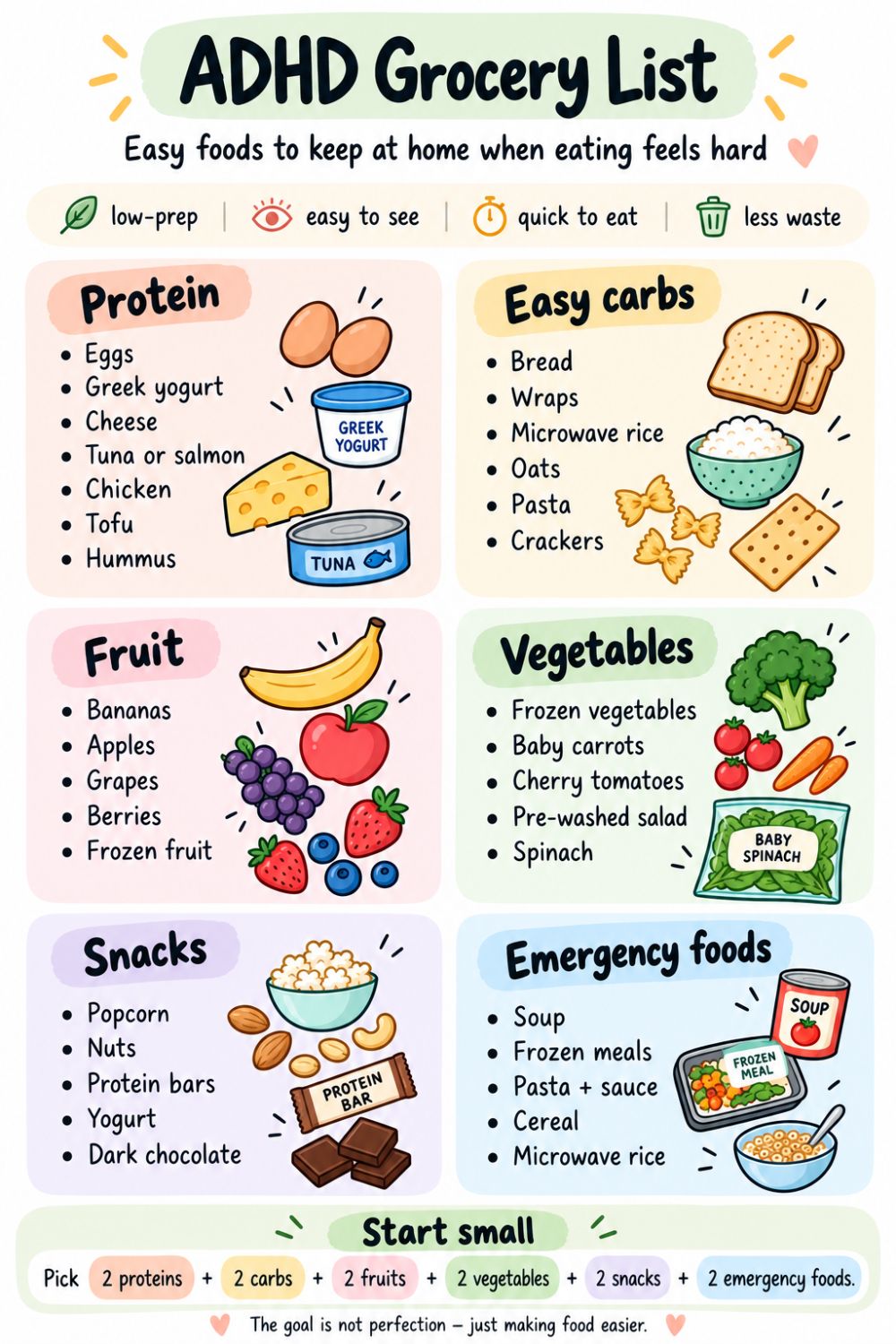
One place where small environmental changes can make a huge difference is the kitchen. Here is my full guide to setting up an ADHD-friendly kitchen with fewer steps and easier access to what you actually use.
ADHD Organization for Work
Work organization often fails because information lives in too many places.
Maybe tasks exist in:
- email,
- Slack,
- notebooks,
- browser tabs,
- calendar,
- screenshots,
- sticky notes,
- your brain.
Try creating one main capture point.
It could be:
- a planner,
- Todoist,
- Notion,
- a notebook,
- or another task manager.
You do not have to run your entire life from one app.
But you should know:
Where does a task go when I need to remember it?
One reliable answer is much easier than five possible answers.
ADHD Digital Organization
Digital clutter is still clutter.
And sometimes it is worse because you cannot physically see how much of it exists.
You may have:
- hundreds of browser tabs,
- thousands of screenshots,
- unread emails,
- duplicate files,
- random notes,
- forgotten apps.
Do not try to organize everything.
Start with the digital spaces that actively cause problems.
For example:
Browser tabs
Bookmark what matters.
Close the rest.
If you truly need 47 tabs for one project, save them as a tab group.
Use a simple rule:
email is communication, not task storage.
If an email requires action, move the action to your task system.
Files
Use broad folders.
You probably do not need a corporate document-management architecture for your personal laptop.
Phone
Put the tools you want to remember on the first screen.
Move distracting apps somewhere less automatic.
Widgets can be especially useful because they let information stay visible without requiring you to remember to open an app.
If you prefer managing tasks digitally, see my guide to the best ADHD planner apps for adults.
ADHD Organization Tools That Actually Reduce Friction
You do not need to buy a house full of organizers.
But a few external tools can genuinely reduce cognitive load.
Useful categories include:
Visual timer
Makes invisible time visible.
Whiteboard
Keeps temporary information in sight.
Clear storage bins
Lets you see what is inside.
Hooks
Remove the steps involved in opening closets or using hangers.
Landing tray or bowl
Creates one home for small essentials.
Paper planner
Externalizes priorities and schedules.
Planner app
Adds reminders, recurring tasks and digital scheduling.
Labels
Reduce the need to remember what belongs where.
Wall calendar
Keeps future events visible.
Smart speaker reminders
Useful when remembering to check your reminder system is the problem.
For more practical tools, I also collected my favorite ADHD-friendly products on Amazon.
What If You Are Actually Good at Organization?
Yes, you can have ADHD and be organized.
Sometimes people become highly organized because they need external systems to compensate.
You may:
- obsessively use calendars,
- create detailed routines,
- always put your keys in exactly one place,
- arrive extremely early,
- keep multiple reminders,
- prepare everything the night before.
From the outside, that can look effortless.
It may not be effortless at all.
A good system can make ADHD difficulties less visible.
So being organized does not automatically tell you anything definitive about whether someone does or does not have ADHD.
ADHD Organization Skills Are Skills — Not Personality Traits
This distinction matters.
You are not:
an organized person
or
a disorganized person
forever.
Organization is a collection of skills and systems.
You can improve:
- task capture,
- prioritization,
- time estimation,
- item storage,
- planning,
- resetting,
- routines,
- reducing clutter.
And you do not have to become excellent at every one of them.
The goal is not becoming someone whose spice jars are alphabetized.
Unless that genuinely makes you happy.
The goal is:
making your environment require less memory, fewer decisions and less executive function.
For more practical tools beyond storage and organization, see my guide to ADHD gadgets that make everyday life easier.
ADHD Organization FAQ
Do people with ADHD struggle with organization?
Many do. Organization depends heavily on executive functions such as working memory, planning, prioritization and task initiation, which can be challenging for people with ADHD.
That does not mean every person with ADHD is visibly disorganized.
Can you have ADHD and be really organized?
Yes. Some people with ADHD develop very strong external systems to compensate for difficulties with memory, time management or task initiation.
Being organized does not rule out ADHD.
What is the best organization system for ADHD?
Usually the simplest system you can use consistently.
Good ADHD organization systems often rely on:
- visible storage,
- designated drop zones,
- broad categories,
- short task lists,
- external reminders,
- and minimal steps.
What are the best ADHD organization tools?
Useful tools can include visual timers, paper planners, planner apps, whiteboards, clear bins, labels, wall calendars, hooks and landing trays.
The best tool depends on the problem you’re trying to solve.
How do I organize my house with ADHD?
Start with one repeated friction point rather than the entire house.
For example:
I keep losing my keys.
Solve that first.
Then move to the next recurring problem.
Small systems are easier to create and maintain than a total-home organization project.
Why do ADHD organization systems stop working?
Sometimes the novelty wears off.
Sometimes the system requires too many steps.
Sometimes your routine changes.
And sometimes the system was built for your ideal day instead of your real one.
Rather than abandoning organization completely, simplify or redesign the part that stopped working.
Are ADHD organization apps helpful?
They can be, particularly if you benefit from reminders, recurring tasks and visual scheduling.
But an app only works if you remember to use it.
For some people, visible physical tools work better.
For others, carrying everything on their phone is much more reliable.
The Bottom Line
Getting organized with ADHD does not have to mean transforming yourself into a permanently tidy, perfectly scheduled person.
You do not need a flawless system.
You need systems that reduce everyday friction.
A useful ADHD organization system should help you:
see what matters,
remember less,
make fewer decisions,
lose fewer things,
and restart easily when life gets messy.
So when something repeatedly ends up in the “wrong” place, try not to immediately ask:
Why can’t I just put this away properly?
Ask:
What would make the right action easier?
Move the basket.
Add the hook.
Remove the lid.
Shorten the list.
Use the timer.
Leave the planner open.
Because the best ADHD organization system is not the one that looks most organized.
It is the one you can actually live with.