Living With ADHD as an Adult: What Everyday Life Actually Feels Like
Last updated: September 14, 2026
Living with ADHD as an adult can be strangely inconsistent.
Some days, you can do ten things before lunch.
Other days, replying to one email feels like a major project.
You may know exactly what you need to do.
You may even know how to do it.
And still feel completely unable to start.
That is one of the hardest parts of adult ADHD to explain.
From the outside, ADHD can look like distraction, forgetfulness or being disorganized.
From the inside, it can feel much bigger than that.
It can affect:
- how you experience time,
- how easily you start tasks,
- how much mental effort basic routines require,
- how you organize your home,
- how you eat,
- how you rest,
- how you work,
- how you manage emotions,
- and how much recovery you need after seemingly ordinary days.
Adult ADHD is also not the same every day.
Your ability to function can change depending on sleep, stress, interest, environment, sensory load, urgency and energy.
That inconsistency can be confusing — especially if you grew up thinking that if you can do something once, you should always be able to do it.
This guide is about what living with ADHD as an adult can actually look like in everyday life — and the systems that can make things a little easier.
If keeping plans in your head is not working, I also compared the best ADHD planner apps for adults →
What Does Living With ADHD Feel Like?
ADHD is usually described through symptoms.
Difficulty focusing.
Impulsivity.
Hyperactivity.
Forgetfulness.
But daily life with ADHD often feels less like a checklist of symptoms and more like constantly managing friction.
Things that seem simple can contain far more steps than they appear to.
For example:
“Leave the house.”
Sounds simple.
But that may actually involve:
- deciding what to wear,
- finding your keys,
- finding your wallet,
- remembering what you need,
- checking the weather,
- packing something,
- estimating travel time,
- stopping whatever you were doing before,
- and actually walking out the door.
Every one of those steps requires executive function.
The same applies to:
“Make dinner.”
“Clean the kitchen.”
“Answer your emails.”
“Go to bed.”
The task itself may not be difficult.
The number of invisible transitions and decisions around it can be.
The current search results for life with ADHD reflect this pretty clearly: executive dysfunction, time blindness, emotional intensity, energy swings, organization and daily routines all appear as central parts of adult ADHD life.
Household tasks can become surprisingly overwhelming when every job contains dozens of small decisions. If this is familiar, start with my ADHD-friendly guide to cleaning when everything feels overwhelming

The Inconsistency Might Be the Hardest Part
I have ADHD, and one of the strangest things about living with it is how inconsistent my capacity can feel.
Something I did easily yesterday can feel almost impossible today.
That does not necessarily mean I forgot how to do it.
Sometimes I have less energy.
Sometimes there is more noise in my head.
Sometimes I have already made too many decisions.
Sometimes I need movement.
Sometimes I need rest.
Sometimes the task is simply not stimulating enough for my brain to engage with it easily.
That inconsistency used to make things feel more personal than they needed to.
It is easy to think:
“Why can’t I just do this? I literally did it yesterday.”
Now I find it more useful to ask:
What changed about my capacity today?
That question usually gets me much further than trying to force myself into functioning exactly the same way every day.
You may also find it useful to reduce the number of decisions your brain has to make. Here are 15 ways to make decisions smaller with ADHD →
Executive Dysfunction: Knowing What to Do but Not Starting
Executive dysfunction is one of the biggest reasons adult ADHD can feel confusing.
You may:
- want to start,
- understand why the task matters,
- know the steps,
- have enough time,
- and still feel stuck.
This can look like procrastination from the outside.
But procrastination often implies:
I do not want to do this yet.
Executive dysfunction can feel more like:
I want to do this, and I still cannot make the first movement happen.
One thing that helps is shrinking the entry point.
Instead of:
clean the kitchen
try:
put three dishes in the sink
Instead of:
work on presentation
try:
open the presentation
Instead of:
organize finances
try:
open the bank app
You are not pretending the entire task is tiny.
You are making the first step small enough to start.
If this is one of your biggest struggles, I have a separate guide on executive dysfunction vs. laziness..
Time Blindness Can Make the Entire Day Feel Weird
Time blindness is not simply being bad with clocks.
You may know exactly what time it is.
And still struggle to feel what that time means.
Ten minutes can feel endless.
Two hours can disappear instantly.
You may underestimate how long tasks take.
Or assume:
“I have plenty of time.”
until suddenly you do not.
This affects much more than punctuality.
It can affect:
- work,
- meals,
- bedtime,
- appointments,
- transitions,
- household tasks,
- and how much you realistically plan into one day.
Externalizing time can help.
Useful options include:
- visual timers,
- time blocking,
- calendar alerts,
- transition alarms,
- visible clocks,
- or planner apps with visual timelines.
If time blindness is one of your main ADHD problems, see my guide to the best ADHD timers for adults.
And if you prefer planning your day visually, I also compared the best ADHD planner apps for adults..
Organization With ADHD Works Better When You Reduce Friction
A lot of traditional organization advice assumes that the main goal is making things look tidy.
For ADHD, I think the more useful goal is:
make the right action easier.
That may mean:
- putting hooks where bags naturally land,
- using open storage instead of hidden drawers,
- keeping keys in one obvious place,
- leaving your planner visible,
- using fewer categories,
- keeping your task list short,
- or removing unnecessary steps from routines.
The best ADHD organization system is not necessarily the prettiest one.
It is the one that still works when you are tired, distracted or already overwhelmed.
I wrote a full guide on ADHD organization and how to build systems your brain can actually maintain..
Decision Fatigue Can Make Tiny Choices Exhausting
Adult life contains an absurd number of decisions.
What should I eat?
When should I start?
Which task is more important?
Should I answer this now?
What should I wear?
What do I need to buy?
What should I do first?
For ADHD brains, repeated decision-making can become exhausting very quickly.
You may notice that by late afternoon, even a small choice feels disproportionately difficult.
Reducing choices helps.
For example:
- repeat breakfast,
- keep a few default meals,
- create fixed homes for important objects,
- limit daily priorities,
- use recurring routines,
- pre-decide what “good enough” looks like.
You do not need more discipline.
Sometimes you simply need fewer decisions.
If this sounds familiar, read Decision Fatigue and ADHD: 15 Ways to Make the Next Choice Smaller..
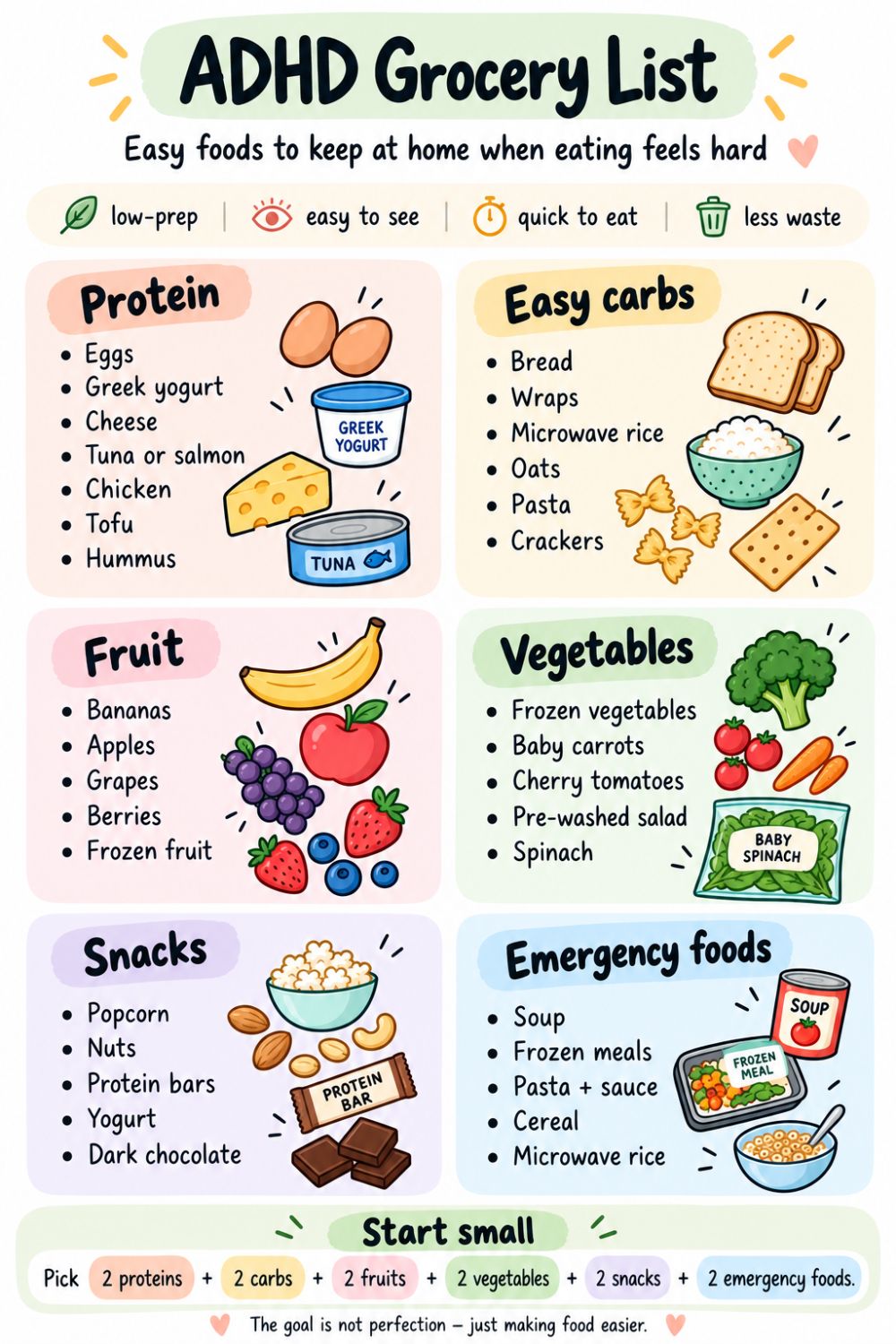
Eating With ADHD Can Be Surprisingly Complicated
Food is one of those areas where ADHD shows up in ways people do not always expect.
You may:
- forget to eat,
- delay meals until you are extremely hungry,
- struggle with meal planning,
- get overwhelmed by cooking,
- eat the same food repeatedly,
- suddenly lose interest in a favorite food,
- crave certain textures,
- or rely heavily on snacks because full meals feel like too many steps.
The problem is not always:
What should I eat?
Often it is:
How do I make eating easy enough that I actually do it?
That is why I think ADHD-friendly food needs to be practical.
Low effort.
Visible.
Predictable.
Easy to assemble.
And good enough to eat even when executive function is low.
Start with my ADHD and food guide for adults.
You may also find these useful:
Living With ADHD Does Not Always Mean Needing More Sleep
Sleep and ADHD are connected, but not always in the way people expect.
Personally, I do not feel like I need dramatically more sleep just because I have ADHD.
What I notice much more is that I need recovery.
And recovery is not always sleep.
Sometimes I need actual sleep.
Sometimes I need to lie down and do nothing productive.
Sometimes I need time without decisions or expectations.
Sometimes I need movement or exercise.
Anxiety affected my actual sleep much more noticeably than ADHD itself.
When I was very anxious, my sleep felt much less restorative. I had intense dreams and woke up more often.
When anxiety is not dominating my system, I can sleep pretty normally with ADHD.
That taught me to separate:
sleep
from
rest
from
recovery.
Sometimes an ADHD brain does not need another two hours of sleep.
It needs two hours without demands.
I wrote more about this in Do People With ADHD Need More Sleep?..
Routines Help — But Rigid Routines Can Backfire
ADHD advice often says:
build routines.
And yes, routines can reduce decision-making.
But a routine only helps if it is easy enough to restart.
You do not need a morning routine with:
- journaling,
- stretching,
- supplements,
- meditation,
- skincare,
- meal prep,
- goal setting,
- reading,
- hydration,
- and twelve other steps.
A useful routine might simply be:
wake up → bathroom → water → medication → coffee
That is enough.
The best routine is not the most impressive one.
It is the one that still happens on a bad day.
If mornings are especially hard, see my ADHD-Friendly Morning Routine for Low-Energy Days.
Work With ADHD Can Feel Like Two Completely Different Jobs
There is the actual work.
And then there is the job of managing your brain so you can do the work.
You may need to manage:
- task initiation,
- distractions,
- hyperfocus,
- transitions,
- meetings,
- deadlines,
- time estimates,
- motivation,
- recovery,
- and interruptions.
This is why “just be more productive” is not especially useful advice.
A more ADHD-friendly approach is to externalize as much as possible.
Use:
- visible deadlines,
- timers,
- task lists,
- calendar blocks,
- body doubling,
- written next steps,
- fewer open projects,
- and realistic daily capacity.
Your brain should not have to hold everything at once.
If knowing what to do but still being unable to start is one of your biggest struggles, read my guide to executive dysfunction vs. laziness →
Hyperfocus Is Useful Until It Is Not
Hyperfocus can feel like a superpower.
You finally get interested in something.
Suddenly:
- four hours disappear,
- you get an enormous amount done,
- you forget lunch,
- ignore messages,
- do not notice you are tired,
- and eventually crash.
Hyperfocus itself is not always bad.
The problem is when it consumes all available energy.
If you know this pattern, it can help to build external interruptions.
For example:
- lunch alarms,
- water reminders,
- visual timers,
- scheduled breaks,
- hard stop times.
The goal is not eliminating deep focus.
It is making sure the rest of your body survives it.
Emotional Intensity Can Be Part of Daily ADHD Life
ADHD is often described primarily as an attention disorder.
But many adults also describe strong emotional reactions, frustration, rejection sensitivity or difficulty returning to baseline after something upsetting.
That does not mean every emotion is “because of ADHD.”
But emotional regulation can require more work.
A small problem may create a disproportionately large nervous-system response.
Then the reaction itself becomes exhausting.
This is another reason recovery matters.
Sometimes the next useful step is not solving the problem immediately.
Sometimes it is:
reduce input first.
Food is another area where executive function matters more than it first appears. Start with my guide to ADHD and food when eating feels hard →
Relationships and ADHD
ADHD can affect relationships too.
Not because people with ADHD care less.
But because behaviors can be interpreted differently from the intention behind them.
For example:
forgetting something may look like not caring.
interrupting may look disrespectful.
needing alone time may look like withdrawal.
losing track of household tasks may look like laziness.
Being chronically late may look inconsiderate.
That does not mean ADHD excuses every behavior.
But understanding the mechanism behind a repeated problem can make it easier to solve together.
Instead of:
“Why do you keep doing this?”
sometimes the better question is:
“What system would make this easier not to forget?”
Can You Live a Normal Life With ADHD?
Yes.
But I think “normal” is not always the most useful goal.
You can absolutely build a life that works well with ADHD.
But some of your systems may look different.
You may:
- use more reminders,
- automate more things,
- eat repetitive meals,
- need more recovery time,
- work in bursts,
- organize things visibly,
- carry duplicate items,
- use timers everywhere,
- or need external structure where other people seem to rely on memory.
That is not automatically a worse way to live.
It is just a more intentional one.
The goal is not to recreate someone else’s brain.
The goal is to build an environment that works better with yours.
Traditional organization systems do not always work well for ADHD brains. I put together a separate guide to ADHD organization systems that are easier to maintain.
What Helps Most With Living With ADHD?
I do not think there is one ADHD system that solves everything.
But a few principles show up again and again.
Make things visible
Important objects.
Tasks.
Time.
Appointments.
Food.
Whatever disappears mentally when it disappears physically.
Reduce steps
If something repeatedly does not happen, ask:
Can I make this require one fewer action?
Use external memory
Your brain does not need to remember everything.
Use:
- reminders,
- planners,
- calendars,
- whiteboards,
- timers,
- notes,
- labels.
Build around your actual behavior
Do not create systems for the person you think you should be.
Create them around what you actually do.
Plan for low-capacity days
If a system only works when you feel great, it is not very resilient.
Allow restarting
You will stop routines.
Forget planners.
Abandon systems.
That does not mean they failed forever.
A useful ADHD system has an easy way back in.
Living With ADHD as an Adult Woman
Adult ADHD can be missed for years, especially in people whose symptoms are less outwardly disruptive.
Some women describe growing up looking:
- responsible,
- high-achieving,
- quiet,
- anxious,
- perfectionistic,
- or simply “scattered.”
The external result may have looked fine while the internal effort was enormous.
This can make later ADHD recognition feel strange.
You may look back at things that used to feel like personal flaws and realize:
there was actually a pattern.
That does not erase responsibility.
But it can replace some confusion with understanding.
Frequently Asked Questions
What is living with ADHD like as an adult?
It varies a lot.
Common challenges can include executive dysfunction, time blindness, organization difficulties, inconsistent focus, emotional regulation, task initiation and managing daily routines.
Some days may feel much easier than others.
Can adults with ADHD live a normal life?
Yes.
Adults with ADHD can build successful, fulfilling lives.
The systems that support them may simply look different, especially around time management, organization, routines and external reminders.
Why does ADHD make daily life feel so exhausting?
Many everyday activities require executive functioning.
Planning, deciding, transitioning, remembering and initiating tasks all use mental resources.
When those processes require more conscious effort, ordinary life can feel surprisingly tiring.
Why can I do something one day but not the next with ADHD?
ADHD performance can vary depending on energy, sleep, interest, urgency, stress, environment, stimulation and executive-function capacity.
Being able to do something once does not guarantee that starting it will feel equally easy every day.
Does ADHD affect organization?
It can.
Organization requires planning, working memory, prioritization and task initiation.
External systems can reduce the amount of information you need to hold mentally.
Does ADHD affect eating?
It can affect eating indirectly through forgetfulness, hyperfocus, sensory preferences, executive dysfunction and inconsistent routines.
Does ADHD affect sleep?
Sleep difficulties are common in people with ADHD, although not every adult with ADHD has major sleep problems.
Are routines good for ADHD?
They can be very helpful because they reduce repeated decision-making.
The best routines are simple, flexible and easy to restart after missed days.
The Dopamenu Takeaway
Living with ADHD is not just about being distracted.
It is about managing attention, time, energy, decisions, transitions, routines and recovery in a brain that does not always respond consistently.
Some days will work beautifully.
Some days will not.
That does not mean you need a completely new personality.
You may just need better external support.
A hook where your bag actually lands.
A timer that makes time visible.
A breakfast you can make without thinking.
Three priorities instead of twenty.
A planner you can restart.
An afternoon with no demands.
A system that works even when your capacity is low.
That is really what Dopamenu is about:
making everyday life require a little less executive function.
Not by forcing your brain to behave differently.
By building a life that works better with the brain you already have.