What Does ADHD Feel Like? The Parts of Adult ADHD You Don’t Always See
Last updated: September 29, 2026
ADHD is often explained as a list of symptoms.
Difficulty paying attention.
Forgetfulness.
Impulsivity.
Hyperactivity.
But that does not always explain what ADHD actually feels like from the inside.
Because ADHD is not simply:
“I get distracted easily.”
Sometimes it feels more like:
“I know exactly what I need to do, but I cannot make myself start.”
Or:
“I have been busy all day, but somehow nothing I meant to do is finished.”
Or:
“I am exhausted, but my brain still wants seventeen different things at once.”
Or even:
“Yesterday I did this easily. Why does it feel impossible today?”
If you are trying to understand what ADHD feels like in adults, this is the part that clinical symptom lists often struggle to capture.
ADHD can affect how you experience:
- attention,
- time,
- motivation,
- emotions,
- energy,
- transitions,
- memory,
- sensory input,
- and the amount of effort everyday tasks seem to require.
And it does not feel exactly the same for everyone.
But there are some experiences that come up again and again.
ADHD Can Feel Like Your Brain Never Fully Goes Quiet
One of the most common descriptions of ADHD is mental noise.
Not necessarily dramatic racing thoughts all day.
Sometimes it is simply:
- a song playing in your head,
- remembering something you forgot yesterday,
- an idea for later,
- noticing a noise outside,
- thinking about dinner,
- remembering you should answer a message,
- wondering whether you locked the door,
- and trying to finish the thing directly in front of you.
All at once.
You may technically be focusing.
There is just a lot happening around the focus.
Some adults describe this as having too many browser tabs open at once.
The current Google results for this query reflect the same idea: rapid thoughts, internal noise and difficulty filtering competing input are some of the most common descriptions of the internal ADHD experience.
ADHD Can Feel Like Wanting to Start — and Still Not Starting
This is one of the hardest things to explain to someone who has never experienced executive dysfunction.
You can:
- know what the task is,
- know how to do it,
- want it finished,
- have enough time,
- understand the consequences,
and still sit there.
Sometimes for an embarrassingly long time.
The task might not even be difficult.
Send email.
Take shower.
Put laundry away.
Open document.
Call dentist.
The gap between:
“I should do this”
and
actually starting
can feel enormous.
That is why ADHD does not always feel like laziness.
Sometimes it feels more like being stuck behind an invisible wall.
If this is the part you relate to most, I wrote a full guide on executive dysfunction vs. laziness..
ADHD Can Feel Like Time Is Not Quite Real
You can look at a clock and understand the numbers perfectly.
But time may still feel strangely abstract.
Five minutes can feel long enough to:
- shower,
- get dressed,
- find your keys,
- pack your bag,
- answer one email,
- and somehow leave the house.
It is not.
But it can feel like it is.
At other times, you sit down for “a few minutes” and suddenly an hour has disappeared.
That experience is often called time blindness.
It may show up as:
- chronic lateness,
- overestimating what fits into a day,
- difficulty stopping enjoyable activities,
- underestimating task duration,
- forgetting future deadlines,
- or constantly feeling surprised by time.
This is one reason external timers and visible schedules can work so well.
If time itself is slippery, making it physical helps.
See my guide to the best ADHD timers for adults if this sounds familiar.
ADHD Can Feel Like You Have Two Speeds
Sometimes:
nothing will start.
Other times:
nothing will stop.
You finally become interested in something and suddenly four hours disappear.
You forget:
- food,
- water,
- messages,
- breaks,
- appointments,
- or the fact that you have a body.
That is hyperfocus.
It can be incredibly productive.
It can also leave you completely drained.
This is one of the strange contradictions of ADHD:
you may struggle enormously to focus on one task…
and then become so intensely focused on another that shifting away feels almost impossible.
ADHD is not simply a lack of attention.
Often it is difficulty regulating where attention goes and when it moves.
ADHD Can Feel Exhausting
This part is easy to underestimate.
An ordinary day may require a surprising amount of mental management.
You may constantly be:
- redirecting your attention,
- reminding yourself what you were doing,
- filtering distractions,
- deciding what matters,
- restarting tasks,
- looking for things,
- correcting your time estimates,
- trying not to interrupt,
- remembering appointments,
- and catching yourself before another rabbit hole.
None of those things looks especially dramatic from the outside.
But together they can be tiring.
Sometimes ADHD exhaustion is not:
“I did too much.”
It is:
“I had to consciously manage too many things that other people seem to do automatically.”
ADHD Can Feel Like Everything Is Easy Until Suddenly It Isn’t
One of the most confusing parts of my own ADHD experience is inconsistency.
I can do something perfectly well.
Then struggle with the exact same thing another day.
That can be incredibly frustrating.
You may think:
“But I know how to do this.”
Yes.
Knowing how to do something and having enough executive-function capacity to initiate and manage it today are not always the same thing.
Capacity can change with:
- sleep,
- stress,
- anxiety,
- sensory load,
- interest,
- novelty,
- hunger,
- hormones,
- environment,
- or how many decisions you have already made.
This is why I find the question:
“Why can’t I do this?”
less useful than:
“What is making this harder today?”
ADHD Can Feel Like Every Small Task Contains Ten Smaller Tasks
Take something simple:
Go grocery shopping.
That actually means:
- decide what food you need,
- check what you already have,
- make a list,
- get dressed,
- find wallet,
- find keys,
- leave house,
- travel there,
- remember list,
- make dozens of small decisions,
- pay,
- carry food home,
- put it away.
That is not one task.
It is a chain of tasks.
And when executive function is low, those chains can feel disproportionately difficult.
This is why breaking things down can help so much.
Not because you do not understand what “clean the kitchen” means.
Because your brain may respond better to:
put cups in sink
than to a vague multi-step project.
ADHD Can Feel Like Too Many Decisions
Some days ADHD feels less like distraction and more like decision overload.
Which task first?
What should I eat?
Should I answer this now?
Should I finish this or switch?
Do I have time?
What should I wear?
What should I buy?
Is this important?
Eventually even small decisions can become strangely difficult.
That is why defaults can help.
Same breakfast.
Same place for keys.
Three priorities.
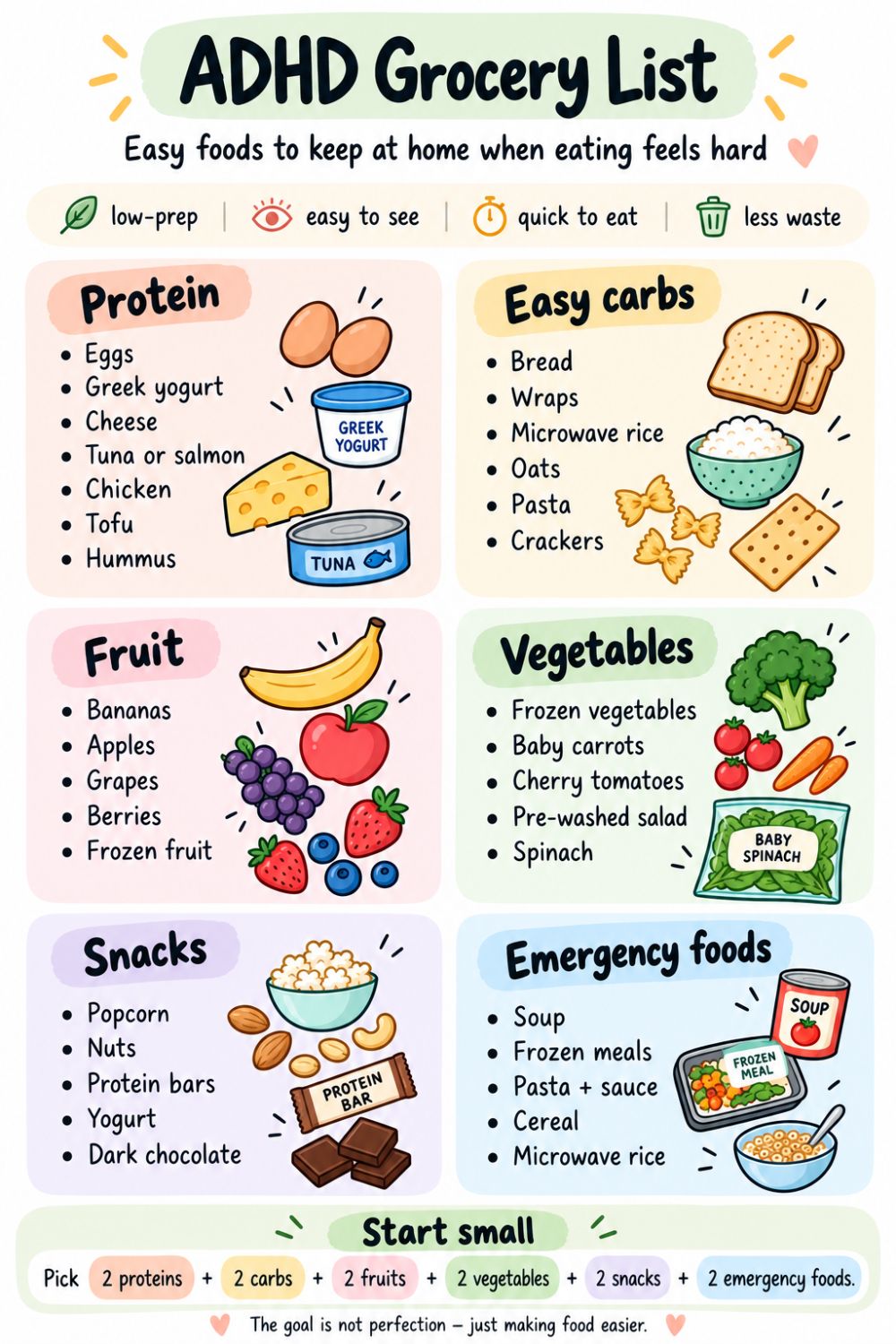
A standard grocery list.
A repeatable morning routine.
You do not need every part of life to be optimized.
Sometimes you need parts of life to be pre-decided.
I wrote more about this in Decision Fatigue and ADHD..
ADHD Can Feel Like You Forget Things You Actually Care About
This can hurt.
You forget:
- a message,
- an appointment,
- someone’s birthday,
- an item you promised to bring,
- something your partner told you,
- a task you genuinely intended to do.
And it can look from the outside like:
you didn’t care enough to remember.
But caring and remembering are not the same cognitive function.
Working memory can be unreliable.
That does not remove responsibility.
But it changes the solution.
Shame does not improve memory very well.
External systems do.
Calendars.
Reminders.
Notes.
Visible objects.
Recurring alerts.
A reliable place to capture information.
ADHD Can Feel Like Your Emotions Arrive at Full Volume
ADHD is usually framed around attention.
But many adults also describe emotional intensity.
Frustration may arrive very quickly.
Excitement can feel enormous.
Rejection can be hard to shake.
A small disruption can temporarily feel much bigger than it objectively is.
The search results for ADHD feels like also strongly reflect this: emotional intensity, frustration and difficulty settling once an emotion has started show up repeatedly in descriptions of the experience.
That does not mean every intense emotion is ADHD.
It means emotional regulation can be another area requiring conscious effort.
ADHD Can Feel Like You Are Always Catching Up
There is often something unfinished.
Laundry.
Email.
Admin.
A form.
A message.
Food shopping.
A half-completed project.
A thing you meant to order.
A thing you ordered and forgot to return.
Even when you are doing plenty, the unfinished things can create the feeling that you are permanently behind.
This can be especially difficult for adults who compensate with perfectionism.
You may appear highly functional from the outside.
Meanwhile internally:
everything feels one forgotten task away from disaster.
ADHD Can Feel Like Boredom Is Physically Uncomfortable
This is another part that can be hard to explain.
Some tasks are not difficult.
They are just painfully unstimulating.
Folding laundry.
Filling out forms.
Waiting.
Listening to a slow explanation.
Doing repetitive admin.
Your brain may start desperately looking for something more interesting.
Phone.
Music.
Snack.
Different task.
Random research.
Anything.
That does not necessarily mean you lack discipline.
ADHD brains often respond strongly to:
- novelty,
- urgency,
- interest,
- challenge,
- and immediate reward.
Unfortunately, “submit insurance paperwork sometime this month” contains almost none of those things.
ADHD Can Feel Like Needing More Recovery Than You Expected
I have also noticed that sometimes what feels like ADHD tiredness is not necessarily a need for more sleep.
Sometimes I need:
- quiet,
- lying down,
- movement,
- time alone,
- something enjoyable,
- or simply a few hours with no expectations attached to them.
That distinction has become important to me.
Because:
sleep
and
rest
and
recovery
are not always the same thing.
Sometimes the best question is not:
“Why am I tired again?”
It is:
“What kind of tired is this?”
I wrote more about that in Do People With ADHD Need More Sleep?..
ADHD Can Feel Like You Are Bad at Things That Are Supposed to Be Easy
This can affect self-esteem over time.
Especially if ADHD was not recognized earlier.
You may spend years asking:
Why can’t I just be on time?
Why do I lose everything?
Why can I do difficult work but forget basic errands?
Why do routines fall apart?
Why can’t I keep my room organized?
Why do I need so many reminders?
When the world repeatedly labels something “easy” that feels hard to you, it is easy to conclude:
the problem must be me.
Learning about ADHD can sometimes replace that vague self-criticism with something more useful:
Maybe I need a different system.
That is not an excuse to never improve anything.
It gives you a better starting point for improvement.
What ADHD Feels Like vs. What ADHD Looks Like
This distinction matters.
ADHD may look like:
lateness
but feel like:
misjudging how long every transition would take.
It may look like:
procrastination
but feel like:
being unable to initiate a task you desperately want finished.
It may look like:
messiness
but feel like:
every item requiring a decision you do not currently have capacity to make.
It may look like:
not listening
but feel like:
trying extremely hard to follow someone while noticing every sound in the room.
It may look like:
inconsistency
but feel like:
not knowing which version of your capacity will show up today.
That difference between the outside behavior and the internal effort is a huge part of understanding ADHD.
Does ADHD Feel Like Depression?
Sometimes there can be overlap in how people describe their experience.
Low motivation, difficulty starting tasks, exhaustion and concentration problems can occur in multiple conditions.
That does not mean ADHD and depression are the same thing.
And feeling mentally tired or unmotivated is not enough to determine which one is happening.
If your mood, motivation or ability to function has changed significantly, especially if it is new or persistent, it is worth discussing with a qualified healthcare professional rather than assuming everything is ADHD.
Can ADHD Feel Like Dementia?
People sometimes search this because forgetfulness can feel frightening.
ADHD can involve difficulties with:
- working memory,
- attention,
- losing objects,
- remembering tasks,
- or recalling something you were not fully attending to in the first place.
But ADHD and dementia are very different conditions.
If memory problems are new, worsening significantly or unusual for you, they deserve medical evaluation rather than being automatically attributed to ADHD.
Can ADHD Feel Like Bipolar Disorder?
There can be superficial similarities in things like impulsivity, emotional intensity or periods of high activity.
But ADHD and bipolar disorder are different conditions with different diagnostic patterns.
A Google symptom comparison cannot reliably tell them apart.
If this is a concern for you personally, a professional assessment is the appropriate next step.
What Feels Like ADHD but Isn’t?
This is actually one of the more useful questions to ask.
Difficulty concentrating or feeling scattered can also happen with:
- sleep deprivation,
- chronic stress,
- anxiety,
- depression,
- medication effects,
- burnout,
- some medical conditions,
- substance use,
- or major life disruption.
That is why identifying with ADHD experiences is not the same thing as receiving an ADHD diagnosis.
You can relate deeply to a description without that description proving what is causing it.
What Does ADHD Feel Like for Me?
For me, ADHD is less:
“I cannot focus.”
and more:
“I cannot always control what my brain decides is focus-worthy.”
I can work intensely on something interesting.
I can learn an enormous amount about something I care about.
I can solve complicated problems.
And then I can spend an absurd amount of energy trying to make myself do something objectively tiny.
It is also the inconsistency.
I may be extremely organized in one area because I have built systems around it…
and completely lose track of something else.
Sometimes I need stimulation.
Sometimes I need silence.
Sometimes exercise helps.
Sometimes I genuinely need to lie down and be left alone.
A lot of living well with ADHD, for me, has become less about forcing myself to function “normally” and more about noticing:
What does my brain need to make this easier?
If This Sounds Familiar, Does It Mean You Have ADHD?
Not necessarily.
Relating to one or even several of these experiences does not diagnose ADHD.
Most people occasionally:
- procrastinate,
- lose track of time,
- forget things,
- become distracted,
- hyperfocus,
- or feel overwhelmed.
ADHD is about a broader and persistent pattern that meaningfully affects functioning.
If you are increasingly thinking:
“I feel like I might have ADHD.”
that can be a good reason to learn more and, if appropriate, talk with a qualified professional.
It does not mean you need to diagnose yourself from a list on the internet.
What Helps When ADHD Feels Like This?
There is no single solution.
But I keep coming back to the same principle:
externalize what your brain struggles to hold internally.
If time is invisible → use timers.
If tasks disappear → write them down.
If objects disappear → keep them visible.
If decisions overwhelm you → create defaults.
If starting is hard → make the first step smaller.
If organization constantly collapses → reduce the number of steps.
If you are exhausted → figure out whether you need sleep, movement, quiet or recovery.
You can explore those systems in my bigger guide to living with ADHD as an adult..
And for specific problems:
- ADHD Organization
- Best ADHD Timers
- Best ADHD Planners for Adults
- ADHD and Food
- Decision Fatigue and ADHD
Frequently Asked Questions
What does ADHD really feel like?
It varies, but adults often describe mental noise, time blindness, difficulty initiating tasks, inconsistent attention, hyperfocus, emotional intensity and mental exhaustion.
The internal effort is often much greater than the behavior looks from the outside.
How does a person with ADHD feel?
There is no universal ADHD experience.
Some people feel mentally restless, overwhelmed or constantly behind. Others struggle more with low activation, forgetfulness, time management or inconsistent motivation.
Does ADHD feel like having too many thoughts?
It can.
Some adults describe having many competing thoughts, ideas or sensory inputs at once and difficulty deciding which one deserves attention.
Why does ADHD feel exhausting?
Managing attention, transitions, working memory, time and task initiation can require constant conscious effort.
That extra mental management can become tiring even on days that do not look particularly demanding.
Can ADHD feel like depression?
There can be overlapping experiences such as low motivation, concentration problems or fatigue, but ADHD and depression are different conditions.
Persistent or significant mood changes should not automatically be attributed to ADHD.
Can ADHD feel like dementia?
ADHD-related working-memory problems and forgetfulness can sometimes feel alarming, but ADHD and dementia are very different.
New or worsening memory problems should be medically evaluated.
Does ADHD get worse with age?
ADHD experiences can change over time, and changing responsibilities, stress, hormones, sleep or health can make symptoms feel more noticeable.
A significant new change should not automatically be assumed to be ADHD.
The Dopamenu Takeaway
ADHD does not simply feel like “being distracted.”
It can feel like:
wanting to start but being stuck,
losing time without noticing,
thinking about five things at once,
being intensely focused and unable to switch,
needing more effort for ordinary tasks,
and never quite knowing how much capacity you will have today.
And that is why ADHD-friendly systems matter.
Not because you need to optimize every second of your life.
But because life becomes easier when fewer things depend entirely on memory, motivation and executive function.
The goal is not to turn your brain into someone else’s.
It is to understand how yours works well enough to stop fighting it every minute of the day.