ADHD-Friendly Jobs: 20 Careers & How to Find Your Fit
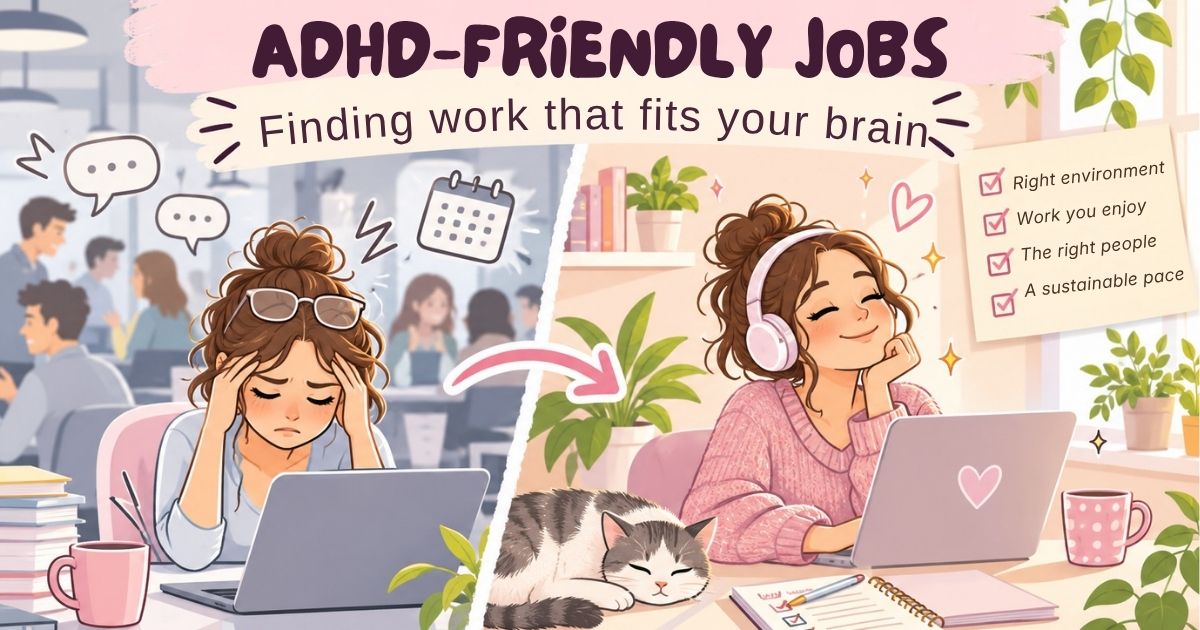
What if you’ve been searching for the perfect career when what you really need is a different working environment?
If you’ve ever Googled “best jobs for people with ADHD,” you’ve probably come across the same suggestions over and over again.
Become an entrepreneur. Work in a creative field. Find something exciting. Choose a fast-paced job where you’ll never get bored.
But what if you love creative work and hate constant interruptions?
What if you’re good at solving problems but find open-plan offices exhausting?
Or what if you genuinely enjoy your profession, yet somehow feel miserable in the environment where you’re expected to do it?
I’ve spent a surprisingly large part of my adult life thinking about questions like these.
And I’ll be honest: my career is still something I’m figuring out.
What I’ve learned along the way is that finding an ADHD-friendly job isn’t necessarily about identifying one perfect profession.
It’s about understanding your interests, working patterns, energy, and the kind of environment that allows you to do your best work.
In this guide, I’ll share 20 careers worth exploring, the challenges that often go unmentioned in job descriptions, and my personal experience of learning what kind of work actually suits me.
Quick Answer: What Are the Best ADHD-Friendly Jobs?
There isn’t one universally best career for adults with ADHD.
However, depending on your interests, skills, and working preferences, the following careers may be worth exploring.
| Career | Why it might appeal | Potential challenge |
|---|---|---|
| Content writer or blogger | Creativity, research, independence | Self-management |
| Graphic designer | Visual problem-solving | Revisions and deadlines |
| Digital marketing specialist | Variety and strategy | Interruptions and multitasking |
| Photographer | Hands-on creativity | Irregular schedules |
| Animator or illustrator | Immersive creative projects | Repetitive production work |
| Chef or baker | Tangible results | Noise and time pressure |
| Hairstylist | Creative, practical work | Busy sensory environment |
| Electrician | Technical problem-solving | Safety and precision |
| Personal trainer | Movement and coaching | Scheduling |
| Teacher or tutor | Meaningful, varied work | Noise and administration |
| Career coach | Deep conversations | Emotional demands |
| Community manager | Relationships and creativity | Constant notifications |
| Event planner | Variety and clear milestones | Unpredictability |
| Software developer | Technical challenges | Long projects |
| Data analyst | Patterns and problem-solving | Detailed repetitive work |
| Quality assurance tester | Structured investigation | Sustained attention |
| Bookkeeper | Predictable routines | Accuracy demands |
| Freelance consultant | Independence and flexibility | Income uncertainty |
| Virtual assistant | Remote work and specialization | Context switching |
| Entrepreneur | Creative control | Managing everything yourself |
These are career possibilities, not jobs scientifically proven to be suitable for everyone with ADHD.
The working conditions matter just as much as the job title.
My Personal Experience: Maybe It Was Never Just About Finding the Right Career
I’ll be honest.
My career has been a long journey of trying to figure out who I am, what I want to do, and where I actually belong.
And I still don’t think I’ve completely figured it out.
I’ve always had an idea of the kind of work I wanted.
Something creative. Something meaningful. Something interesting enough to keep learning, exploring ideas, and solving problems.
But there was something I hadn’t really considered when imagining my dream career.
The working environment wasn’t part of the job description.
You apply for a role because the responsibilities sound exciting.
You picture yourself developing ideas, working on interesting projects, using your skills, and contributing something valuable.
And then you discover everything else that comes with it.
Open-plan offices.
People constantly walking around.
Conversations happening everywhere.
Bright lights.
Meetings scattered throughout the day.
And, of course, the famous:
“Hey, just a quick question!”
Which somehow always arrives when you’ve finally managed to concentrate.
Sometimes, there’s not even a quiet moment during lunch.
For a long time, I didn’t fully understand why environments like these affected me so much.
ADHD only became something I started seriously considering after turning 30. And who knows? Maybe there are other things about the way I function that I’m still discovering. 🙂
But looking back, a lot of my experiences make more sense now.
I Love Working. I Just Don’t Love Every Working Environment.
One of the biggest discoveries I’ve made is how much I enjoy working from home.
And I don’t mean because I can work less.
Quite the opposite.
I can get so much more done when I have control over my environment.
I can concentrate without constant interruptions.
I can organize my day around the work that actually needs my attention.
I don’t have to keep adjusting to conversations, movement, lights, and other people’s schedules.
And at the end of the day, I feel much more satisfied with how I’ve spent my time.
That matters enormously to me.
For years, I focused on finding work that matched my interests and abilities.
Today, I’ve realized that the environment and the people around me can matter even more than the specific job title.
Of course, I still want my work to feel meaningful.
I want to use my skills, contribute something, and feel that what I’m doing matters.
But I’ve realized that even a job I love can become exhausting in the wrong environment.
And a role that doesn’t sound like my ultimate dream job might actually make me happier if it comes with the right people, independence, and working conditions.
Why Marketing and Blogging Still Feel Right for Me
Despite all my questions about career identity, there’s one thing I keep coming back to.
I love exploring ideas.
And that’s probably why digital marketing and blogging have remained such important parts of my life.
I work in marketing and run multiple blogs, which allows me to explore all sorts of interests.
I get to research new topics, write, create content, analyze data, develop strategies, experiment, and solve problems.
I don’t have to choose between being creative and analytical.
I can be both.
And for someone who has a lot of different interests, that’s a pretty wonderful combination.
It means I can follow my curiosity while building something meaningful.
Of course, independent work brings its own challenges.
Managing projects, estimating how long tasks take, planning realistically, and creating structure don’t always happen automatically.
I’ve had to learn a lot about time management, and I’m still learning.
I wrote more about these experiences in my guide to living with ADHD as an adult.
But working independently gives me something I value enormously:
The possibility of creating an environment and a way of working that actually suit me.
And maybe that’s what I’ve been looking for all along.
Not one perfect job title that finally explains who I am.
But a way of working that gives me room to be myself.
What Actually Makes a Job ADHD-Friendly?
An ADHD-friendly job isn’t necessarily exciting, flexible, or easy.
It’s a job where the demands of the role are reasonably compatible with your abilities, preferences, and support needs.
A 2024 systematic review published in Neurodiversity examined 79 studies involving more than 68,000 people with ADHD.
One of its important conclusions was that person-environment fit, workplace accommodations, and support can play a significant role in occupational experiences.
In other words, we shouldn’t look only at the individual or only at the job description.
We also need to consider the environment.
Five Things I Would Look For
1. The right level of stimulation
Some people enjoy busy environments with constant activity.
Others need quiet, fewer interruptions, and more time to concentrate.
Neither preference is inherently better.
2. Clear expectations
Knowing what’s expected, which tasks matter most, and when something needs to be finished can reduce unnecessary uncertainty.
3. Autonomy
Being able to decide how to approach your work may be especially valuable if you have developed your own effective systems.
4. Manageable transitions
A job with meetings every 30 minutes might look perfectly organized on paper.
But if you need uninterrupted time to do complex work, that schedule can become exhausting.
5. Supportive colleagues and managers
A manager who communicates expectations clearly and respects focus time can make a real difference.
This is why I believe a supportive working environment deserves just as much attention as the actual profession.
20 ADHD-Friendly Jobs Worth Exploring
I’ve grouped these careers by working style rather than ranking them from best to worst.
As you read, pay attention to the working conditions, not just the career descriptions.
Creative Jobs for Adults With ADHD
Creative careers may appeal to people who enjoy variety, curiosity, experimentation, and problem-solving.
But creative work often involves deadlines, revisions, administrative tasks, and managing several projects at once.
1. Content Writer or Blogger
Writing can be a great way to combine creativity, research, and independent work.
You might write articles, newsletters, website content, educational materials, or marketing campaigns.
What may work well: Variety, opportunities for deep focus, flexible schedules, and creative problem-solving.
What may be difficult: Managing deadlines, editing, self-organization, and estimating project time.
As a blogger, I’ve learned that writing is only one part of content creation. Research, planning, thinking, editing, and measuring results all require time.
If you enjoy the full process, writing can be deeply rewarding.
2. Graphic Designer
Graphic design offers opportunities to solve visual problems and create something tangible.
What may work well: Creative projects, visual thinking, and varied assignments.
What may be difficult: Subjective client feedback, frequent revisions, and multiple deadlines.
A quiet design studio and a busy advertising agency could feel like completely different jobs.
3. Digital Marketing Specialist
Marketing brings together creativity, strategy, psychology, communication, and analytics.
What may work well: New challenges, experimenting, developing ideas, and measurable results.
What may be difficult: Constant messages, changing priorities, meetings, and multitasking.
I think this is a perfect example of why the job title alone isn’t enough.
A content strategist who works independently on long-term projects may have a completely different experience from someone managing real-time social media responses all day.
4. Photographer or Video Creator
Visual content creation offers a combination of creativity and practical work.
What may work well: Interesting projects, hands-on work, and tangible results.
What may be difficult: Irregular hours, equipment management, detailed editing, and client communication.
5. Animator or Illustrator
Animation and illustration can involve immersive creative work and opportunities to develop specialist skills.
What may work well: Visual storytelling, creative problem-solving, and focused projects.
What may be difficult: Repetitive production stages, detailed revisions, and long deadlines.
Active and Hands-On Careers
Some adults prefer work that involves movement, practical tasks, and immediate feedback.
6. Chef or Baker
Cooking and baking offer practical creativity with visible results.
What may work well: Hands-on tasks, variety, and clear outcomes.
What may be difficult: Noise, heat, pressure, interruptions, and demanding schedules.
A calm artisan bakery might suit someone very differently from a busy restaurant kitchen.
7. Hairstylist
Hair styling combines creative work with personal interaction and practical skills.
What may work well: Varied clients, tangible progress, and creative expression.
What may be difficult: Busy salons, social demands, and back-to-back appointments.
8. Electrician or Skilled Tradesperson
Skilled trades often involve solving practical problems and using specialized technical skills.
What may work well: Clear tasks, hands-on learning, and varied projects.
What may be difficult: Documentation, scheduling, accuracy, and safety-critical procedures.
Proper training, supervision, and reliable safety systems are essential. These careers aren’t automatically suitable for everyone with ADHD.
9. Personal Trainer
Personal training combines movement, education, and helping others work toward goals.
What may work well: Active workdays, personal connection, and visible progress.
What may be difficult: Scheduling clients, managing your business, and maintaining consistent working hours.
People-Focused Careers
Some people enjoy meaningful interactions and helping others solve problems.
Others find prolonged social demands exhausting.
10. Teacher or Tutor
Teaching can offer variety, creativity, and meaningful work.
What may work well: Developing lessons, explaining ideas, and seeing students progress.
What may be difficult: Noise, simultaneous demands, administrative tasks, and interruptions.
Individual tutoring may offer a quieter alternative to traditional classroom teaching.
11. Career Coach
Coaching focuses on supporting people as they explore goals, choices, and challenges.
What may work well: Deep conversations, meaningful relationships, and problem-solving.
What may be difficult: Emotional demands, documentation, scheduling, and follow-up.
12. Community Manager
Community management involves building connections and encouraging engagement.
What may work well: Communication, creativity, and relationship-building.
What may be difficult: Constant notifications, conflict moderation, and unpredictable requests.
13. Event Planner
Event planning combines creativity, logistics, deadlines, and working with people.
What may work well: Variety, clear milestones, and problem-solving.
What may be difficult: Changing priorities, time pressure, and unexpected issues.
If you enjoy planning but dislike constant last-minute changes, this distinction matters.
Structured and Analytical Jobs
Not everyone with ADHD needs excitement or constant novelty.
Some people prefer predictable routines, technical challenges, or clearly defined procedures.
14. Software Developer
Software development involves building digital systems and solving technical problems.
What may work well: Interesting challenges, independent work, and focused problem-solving.
What may be difficult: Long projects, debugging, and frequent interruptions.
15. Data Analyst
Data analysis involves investigating information and finding meaningful patterns.
What may work well: Structured questions, measurable results, and analytical thinking.
What may be difficult: Repetitive data cleaning and attention to detail.
16. Quality Assurance Tester
Quality assurance focuses on testing products, processes, or software.
What may work well: Clear procedures, defined expectations, and systematic problem-solving.
What may be difficult: Repetition, documentation, and detailed checking.
17. Bookkeeper
Bookkeeping involves organizing financial records and following established procedures.
What may work well: Predictability, clear rules, and structured workflows.
What may be difficult: Repetitive tasks, strict deadlines, and accuracy requirements.
Independent and Flexible Careers
Greater independence can make it easier to control your schedule and environment.
But it also means taking responsibility for creating your own structure.
18. Freelance Writer or Consultant
Freelancing can offer flexibility and the ability to choose projects.
What may work well: Autonomy, working from home, and varied assignments.
What may be difficult: Inconsistent income, client expectations, administrative work, and self-management.
I think it’s important to distinguish between enjoying independence and finding independent work easy.
Those are two different things.
19. Virtual Assistant
Virtual assistants help businesses with administrative, organizational, or creative tasks.
What may work well: Remote opportunities, specialized services, and structured workflows.
What may be difficult: Context switching, competing priorities, and interruptions from multiple clients.
20. Entrepreneur or Small Business Owner
Entrepreneurship can offer the freedom to create something around your own interests and skills.
What may work well: Independence, creative control, and opportunities to explore new ideas.
What may be difficult: Financial uncertainty, administrative work, decision fatigue, and managing everything yourself.
As someone who runs blogs, I appreciate the freedom that comes with developing my own projects.
But freedom doesn’t eliminate the need for structure.
It simply gives you more responsibility for creating it.
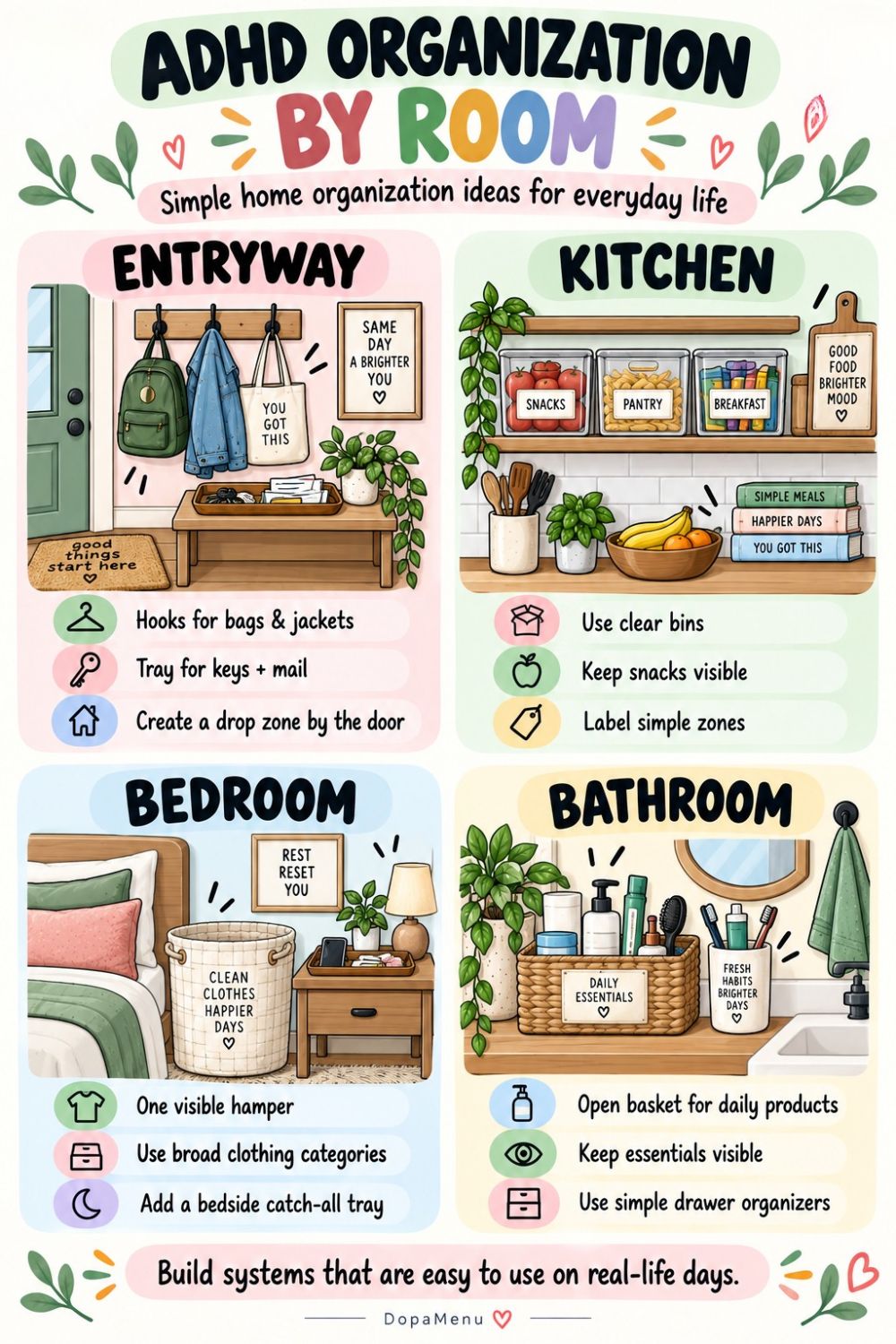
If you’re interested in building systems that make everyday responsibilities easier, my guide to ADHD organization is a useful starting point.
ADHD-Friendly Jobs for Inattentive ADHD
If you primarily struggle with inattention, distractibility, forgetfulness, or difficulties starting tasks, you may have very different workplace preferences from someone who seeks constant stimulation.
For example, you might do well with:
- Longer periods of uninterrupted concentration
- Written instructions
- Visible deadlines
- Predictable schedules
- Clear task priorities
- Quiet workspaces
- Regular, constructive feedback
That doesn’t mean you have to choose a quiet desk job.
It means paying attention to the specific demands of a role.
A software developer might have a quiet workplace with long focus periods, or a noisy office full of meetings.
A marketing specialist might enjoy independent creative projects, or spend the entire day answering urgent messages.
The same profession can offer completely different working experiences.
If starting tasks is one of your biggest challenges, I also recommend reading my article on ADHD organization and practical systems that reduce everyday friction.
ADHD-Friendly Jobs for Women
You may have searched for “best ADHD jobs for women” or “inattentive ADHD jobs for women.”
But there isn’t a separate set of professions that automatically suits women with ADHD.
What may be particularly relevant is how individual attention difficulties interact with workplace expectations, caregiving responsibilities, social demands, and career opportunities.
Some women only begin exploring the possibility of ADHD as adults.
That was part of my experience, too.
When you’ve spent years trying to understand why certain situations feel harder than expected, career decisions can become tangled up with your sense of identity.
You might question your ability, your motivation, or whether you’ve chosen the wrong profession.
But understanding your working preferences can be a much more useful starting point than choosing a career based on a label.
ADHD and Anxiety: Is a Quiet Job Better?
Not necessarily, but a quieter environment can be helpful for people who find noise and interruptions draining.
For me, having greater control over my surroundings makes an enormous difference.
I love being able to work without constant conversations, bright office lights, and unexpected interruptions.
But someone else may feel isolated or unmotivated working alone.
The goal isn’t to find the least stimulating job possible.
It’s to understand your preferred level of stimulation and your need for predictability.
If ADHD-related difficulties occur alongside anxiety, it may be worth considering how much uncertainty, social pressure, and unpredictability a job involves.
A good question to ask is:
How much energy does this job leave me with after the workday ends?
Because enjoying the work itself doesn’t automatically mean the overall experience is sustainable.
Is Working From Home Better for Adults With ADHD?
Remote work can be incredibly helpful for some adults with ADHD.
It may reduce commuting, office noise, unplanned interruptions, and some forms of social pressure.
It can also provide more control over lighting, breaks, and your physical workspace.
But remote work isn’t automatically better for everyone.
Some people struggle with isolation, maintaining routines, starting tasks, or separating work from personal life.
Why Working From Home Works Better for Me
For me, working from home has been one of the clearest examples of how much the environment matters.
I can spend more of my energy on the actual work instead of constantly adjusting to what’s happening around me.
And that doesn’t just affect my output.
It affects how I feel about my day.
I can finish work knowing I’ve used my time in a way that makes sense to me.
However, I still need calendars, time management techniques, and realistic planning systems.
I’ve found that independence works best when I combine it with enough structure.
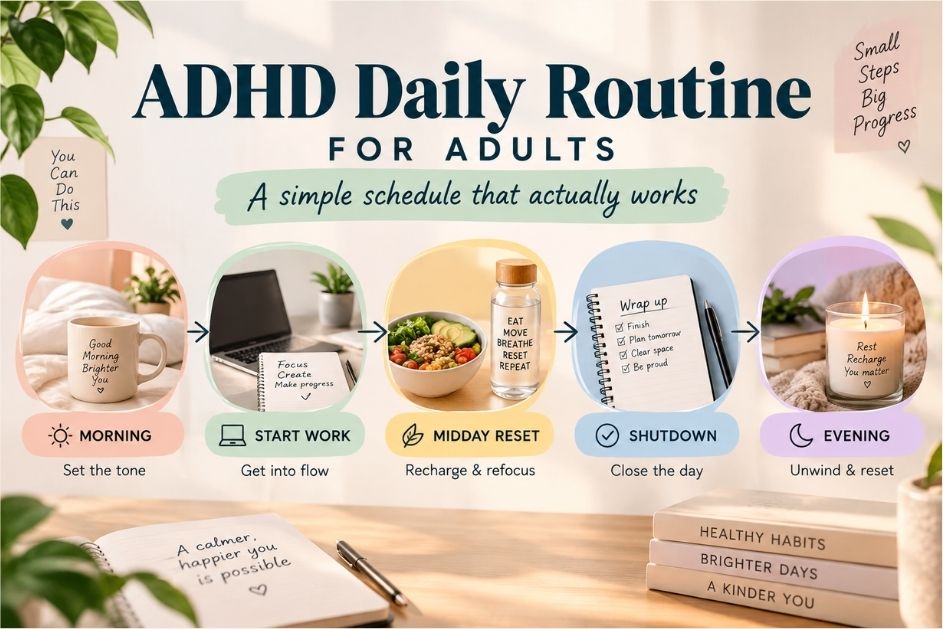
If you’re looking for ways to organize an independent workday, my ADHD daily routine for adults explains how I approach flexible schedules without relying on a rigid minute-by-minute plan.
The Hidden Problem With Open-Plan Offices
Open-plan offices are often presented as collaborative and modern.
And for some teams, they work well.
But they may also create challenges for people who need concentration or a lower level of sensory input.
Consider how many things can interrupt a working day:
- Colleagues asking spontaneous questions
- Conversations happening nearby
- People walking past your desk
- Bright or uncomfortable lighting
- Meetings that divide the day into small fragments
- Limited opportunities for quiet breaks
- Pressure to appear constantly available
The problem isn’t necessarily one single interruption.
It’s the cumulative effect of repeatedly having to redirect your attention.
Personally, I find it much easier to develop ideas and work through complex problems when I have longer periods of uninterrupted time.
That doesn’t mean I don’t enjoy collaborating.
I simply prefer collaboration that leaves enough space for individual thinking, too.
What Could Make an Office More ADHD-Friendly?
Some practical possibilities include:
- Quiet rooms or designated focus areas
- Adjustable lighting where possible
- Written communication instead of unnecessary meetings
- Scheduled collaboration periods
- Flexible working hours
- Remote or hybrid work options
- Clear expectations about availability
- Permission to use appropriate noise-reducing tools
These arrangements may help many employees, not only people with ADHD.
What If You Love Your Profession but Hate Your Job?
This is the question I wish more career guides explored.
Because sometimes the work itself isn’t the problem.
Maybe you love writing but hate being interrupted every ten minutes.
Maybe you enjoy marketing but feel overwhelmed by constant meetings.
Maybe you love helping people but need quiet time between conversations.
Maybe you enjoy problem-solving but feel frustrated by unclear expectations.
Instead of immediately assuming you’ve chosen the wrong profession, try separating three questions.
1. Do I enjoy the actual work?
Think about the activities themselves, rather than the job title.
2. Do I enjoy the way I’m expected to work?
Consider your schedule, responsibilities, flexibility, and degree of independence.
3. Do I feel comfortable in the working environment?
Think about noise, lighting, colleagues, leadership, communication, and interruptions.
These are different questions.
And they may lead to different solutions.
You might discover that you need a different career.
But you might also discover that you need a different workplace, team, or working arrangement.
How to Find an ADHD-Friendly Career That Actually Fits You
Step 1: Identify the Work You Naturally Enjoy
Think about the tasks that capture your interest.
Do you enjoy writing, creating, researching, organizing, solving problems, helping people, or building things?
Don’t worry about choosing one perfect professional identity.
Look for recurring activities you genuinely enjoy.
For me, the common thread is curiosity, creativity, and problem-solving.
That’s why marketing and blogging give me room to explore different interests without feeling that I must choose just one.
Step 2: Identify the Environments That Drain You
Think about where you’ve struggled in previous jobs or educational settings.
Was it the work itself?
Or was it something around the work?
For example:
- Noise
- Constant interruptions
- Too many meetings
- Unclear responsibilities
- Lack of independence
- Unpredictable schedules
- Difficult workplace relationships
- Limited recovery time
Try to notice patterns.
You may discover that the same challenges appear across completely different jobs.
Step 3: Find Your Ideal Balance Between Structure and Freedom
Some people need clear routines to feel comfortable.
Others need considerable flexibility.
Many need both.
For example, you might prefer:
- Clear deadlines but flexible working hours
- Independent work with regular check-ins
- Creative projects with written briefs
- Predictable meetings but freedom between them
- A visible task list without constant supervision
If you want help finding a simple planning system, I’ve compared seven ADHD planner apps for adults that approach structure and scheduling differently.
Step 4: Pay Attention to Workplace Culture During Interviews
A job interview isn’t only an opportunity for an employer to evaluate you.
It’s also your chance to understand the environment you’re considering.
Some useful questions include:
- What does a typical workday look like?
- How often does the team have meetings?
- How are priorities communicated?
- Is there time for uninterrupted work?
- What is the office environment like?
- Are remote or hybrid arrangements possible?
- How does the team handle unexpected requests?
- How is feedback usually provided?
I would pay particular attention to how people respond to these questions.
Clear, thoughtful answers can tell you a lot about how a team works.
Step 5: Experiment Before Making a Major Change
You don’t always need to quit your job or start an entirely new career to explore what might suit you.
You could:
- Take a short course
- Try a personal creative project
- Volunteer in a field you’re interested in
- Talk to someone who works in that profession
- Experiment with freelance work
- Request changes to your current working arrangements
Small experiments can help you discover what you enjoy without making every career decision feel permanent.
ADHD Career Fit Checklist: What Do You Actually Need?
Before applying for a new job, rate the following from 1 (not important) to 5 (extremely important).
| Workplace preference | Score |
|---|---|
| Creative freedom | 1–5 |
| Quiet working environment | 1–5 |
| Flexible working hours | 1–5 |
| Clear instructions and deadlines | 1–5 |
| Opportunities to learn | 1–5 |
| Independence | 1–5 |
| Predictable routines | 1–5 |
| Regular social interaction | 1–5 |
| Meaningful work | 1–5 |
| Supportive management | 1–5 |
| Remote work options | 1–5 |
| Uninterrupted focus time | 1–5 |
Now look at your highest scores.
These aren’t necessarily things you should compromise on just because a job sounds exciting.
Use them as questions to explore during your next job search.
This is a personal reflection exercise, not a diagnostic or validated career assessment.
You May Not Need a New Career — Just Better Working Systems
Sometimes, changing how you work can make a meaningful difference.
If you enjoy your profession but struggle with daily organization, consider experimenting with simple supports.
For example:
If you underestimate project time: Track how long different stages actually take, including research, planning, creative thinking, and revisions.
If you struggle to begin: Break the task into a smaller first action.
If you lose track of your priorities: Keep a short, visible daily task list.
If constant interruptions affect you: Try scheduling protected focus periods.
If your workday lacks structure: Use a few repeatable anchors rather than a rigid schedule.
You can explore more ideas in my ADHD daily routine guide and ADHD planner app comparison.
These strategies won’t fix an unhealthy workplace culture or unreasonable demands.
But they may help you understand which challenges can be addressed with personal systems and which require changes to the working environment itself.
Frequently Asked Questions About ADHD-Friendly Jobs
What is the best job for someone with ADHD?
There is no single best job for everyone with ADHD. Creative, structured, technical, active, and people-focused careers can all be suitable depending on individual skills, interests, and working conditions.
What are the best ADHD-friendly jobs for women?
The best career depends more on individual preferences and support needs than gender. Consider autonomy, working environment, flexibility, career opportunities, and responsibilities outside work.
What jobs are good for inattentive ADHD?
Jobs with clear priorities, written instructions, manageable interruptions, and opportunities for focused work may be worth exploring. However, suitability depends on the individual and the specific workplace.
Can adults with ADHD be successful entrepreneurs?
Yes. Some adults with ADHD enjoy the independence and creative possibilities of entrepreneurship. However, managing finances, deadlines, and administration can create additional challenges. ADHD alone doesn’t predict business success.
Are remote jobs good for adults with ADHD?
Remote work can help some people by reducing interruptions and providing control over the environment. Others may prefer the structure and social interaction of an office.
What are some high-paying ADHD-friendly jobs?
Potentially well-paid options include software development, data analysis, specialized consulting, digital marketing leadership, and skilled technical professions. Actual earnings depend on experience, location, qualifications, industry, and the role.
What jobs should people with ADHD avoid?
There is no universal list of careers everyone with ADHD should avoid. Instead, evaluate the demands, safety requirements, work environment, and support available in each role.
Should I tell my employer I have ADHD?
Disclosure is a personal decision. It may depend on whether you need formal accommodations, your working relationship, and local employment protections. Requirements and rights differ by country, so seek relevant professional advice when needed.
What if I still don’t know what career I want?
That’s okay. You don’t have to resolve your entire professional identity before making a useful next step.
Start by identifying what kind of work and environment you enjoy, then explore possibilities through smaller experiments.
Career development doesn’t have to follow one perfectly linear path.
Final Thoughts: Maybe the Right Career Is About More Than What You Do
I used to think finding the right career meant finding the perfect answer to one question:
What do I want to be?
And honestly, it’s a question I’m still exploring.
But now I think there are other questions that matter just as much.
Where do I want to work?
Who do I want to work with?
How do I want my days to feel?
What kind of environment allows me to concentrate, contribute, and still have energy left for the rest of my life?
I’ve learned that I can love creative work and still need quiet.
I can enjoy independence and still need structure.
I can have many interests without needing to turn each one into a separate career.
And I can be good at something without wanting to spend every day doing it under any conditions.
Maybe finding an ADHD-friendly job isn’t about discovering one magical profession that solves everything.
Maybe it’s about understanding your needs well enough to recognize when a workplace truly fits.
Because the right job in the wrong environment can still be the wrong job.
And sometimes, the most meaningful career change isn’t changing what you do.
It’s changing the way you’re able to do it.
Research and Further Reading
Hotte-Meunier, A., et al. (2024). Strengths and Challenges to Embrace Attention-Deficit/Hyperactivity Disorder in Employment—A Systematic Review. Neurodiversity. Read the research.
Facilitators and Barriers to Employment of Neurodivergent Individuals (2025). A Systematic Literature Review of Employee and Employer Experiences. Read the research.
CHADD. Workplace Issues. ADHD workplace resources.
Disclaimer: This article is based on personal experiences and general research. It is intended for educational purposes and is not a substitute for professional medical, psychological, legal, or individual career advice.