ADHD Daily Routine for Adults: A Simple Schedule That Actually Works
Last updated: September 17, 2026
If traditional routines have never worked for you, the problem may not be that you are “bad at routines.”
A lot of daily schedules are built around an ideal version of life:
wake up at the same time, exercise, journal, eat a perfect breakfast, start work early, stay focused all day, cook dinner, clean the kitchen, prepare for tomorrow and go to bed on time.
That sounds organized.
It can also become exhausting very quickly.
For me, a more useful ADHD daily routine is not a strict timetable.
It is a small set of repeatable anchors that help me know what happens next without having to make every decision from scratch.
The goal is not to follow a perfect schedule.
The goal is to make everyday life slightly easier to restart.
Quick Answer: What Is a Good Daily Routine for Adults With ADHD?
A realistic ADHD-friendly routine usually works better when it includes:
- a small number of predictable anchors;
- visible reminders;
- fewer decisions;
- realistic transition time;
- easy food options;
- planned breaks;
- simple task-starting cues;
- an evening reset;
- a low-energy version for difficult days.
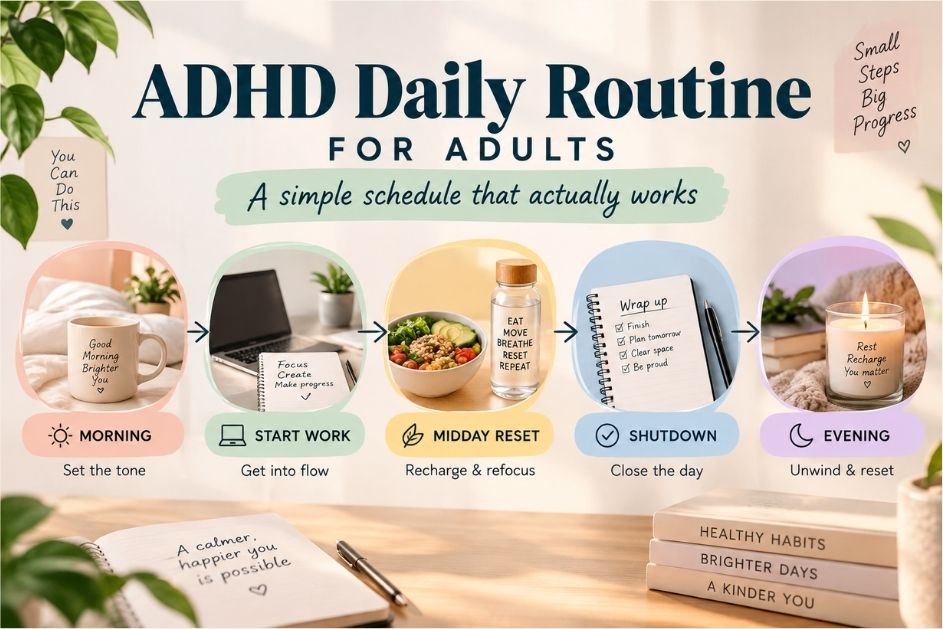
Instead of trying to schedule every hour, start with five anchors:
Morning → Start Work → Midday Reset → End Work → Evening
Then build small routines around those moments.
Why Daily Routines Can Feel So Hard With ADHD
The difficult part is often not understanding what needs to happen.
You may already know that you should:
- get dressed;
- eat;
- answer messages;
- start work;
- take breaks;
- clean up;
- prepare for tomorrow;
- go to bed.
The hard part can be starting, sequencing and switching between those things.
That is why a routine with twenty tiny steps can actually create more friction.
I prefer routines that answer one question:
What do I do next?
A useful routine reduces the amount of thinking required at predictable points in the day.
My ADHD-Friendly Routine Rule: Use Anchors, Not Perfect Times
For me, routines become much easier when I attach them to events instead of exact times.
Instead of:
7:10 shower
7:25 breakfast
7:45 planning
8:00 work
I would use:
After I wake up → morning anchor
Before I start work → work-start anchor
Around lunch → midday reset
When I finish work → shutdown anchor
Before bed → evening anchor
Why?
Because real days move.
You sleep late.
A meeting changes.
You have a bad night.
You get hyperfocused.
Something takes longer.
An anchor can survive that.
A minute-by-minute routine often cannot.
A Simple ADHD Daily Routine for Adults
Here is the basic structure I would start with.
Morning Anchor
Keep the morning routine small enough that it still works on an average day.
For example:
- drink water;
- bathroom + basic hygiene;
- get dressed;
- eat something;
- look at today’s priorities;
- start the first task.
That is enough.
You can add exercise, journaling, meditation or anything else if you genuinely enjoy it.
But I would not make optional wellness habits a requirement for having a “successful” morning.
ADHD Morning Routine Example
A realistic morning might look like:
Wake up
- open curtains;
- drink water;
- bathroom;
- get dressed.
Eat
Choose from a few pre-decided breakfasts instead of inventing breakfast every day.
For example:
- yogurt + granola;
- eggs + toast;
- protein cereal;
- smoothie;
- overnight oats;
- something you can simply grab.
If food decisions are often difficult for you, my ADHD-friendly food ideas and high-protein snack list can help you create a small rotation instead of deciding from scratch every day.
Orient yourself
Ask:
What actually matters today?
Choose:
- one important task;
- one useful task;
- everything else = optional / later.
I would rather have three visible priorities than a 27-item to-do list I stop seeing after ten minutes.
The ADHD Work-Start Routine
Starting work deserves its own routine.
Because “sit down and work” is not really one step.
My start sequence might be:
- get a drink;
- clear the visible workspace;
- put phone away;
- open only the file I need;
- turn on focus music;
- write the smallest first step;
- set a 10-minute timer.
For example:
Not:
Write article.
But:
Open WordPress and write the H1.
Not:
Do accounting.
But:
Open the spreadsheet.
Not:
Clean inbox.
But:
Answer the first important email.
Starting smaller does not mean your goal is smaller.
It just lowers the cost of beginning.
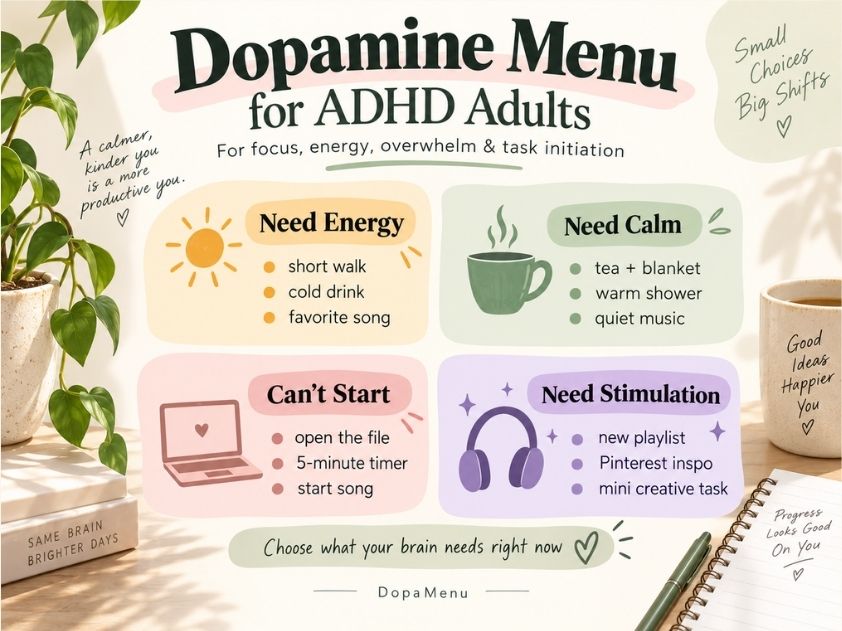
Use a Dopamine Menu for Work Breaks
This is where my dopamine menu becomes genuinely useful.
When I take a break, I do not always need more entertainment.
Sometimes I need:
- energy;
- calm;
- stimulation;
- movement;
- an easier way back into work.
Instead of automatically opening my phone, I can look at a short menu.
For example:
Need energy?
- short walk;
- favorite song;
- cold drink;
- crunchy snack.
Need calm?
- tea;
- fresh air;
- quiet music;
- quick shower.
Need stimulation?
- new playlist;
- photography;
- five minutes of Pinterest;
- mini creative task.
Can’t restart?
- start song;
- open the next file;
- five-minute timer;
- body doubling.
You can see my Dopamine Menu for ADHD Adults for more ideas.
Midday ADHD Reset Routine
The middle of the day is where routines often disappear.
You may have:
- forgotten to eat;
- gotten stuck in hyperfocus;
- switched between too many tasks;
- accumulated clutter;
- opened 36 browser tabs.
So instead of adding another productivity block, I like a short reset.
Try:
- eat;
- refill water;
- bathroom;
- move your body;
- close unnecessary tabs;
- check your remaining priorities;
- deliberately drop something that no longer matters.
That last one is important.
A midday reset is not only for adding tasks.
It is also a chance to reduce the rest of the day.
ADHD-Friendly Lunch Routine
Meals can become surprisingly complicated when attention is already somewhere else.
Instead of relying on hunger + inspiration + available ingredients all happening at the same time, create a few defaults.
For example:
Low effort
- sandwich;
- yogurt + fruit + granola;
- eggs + toast;
- frozen meal + vegetables;
- snack plate;
- leftovers.
Very low effort
- protein bar;
- cheese + crackers;
- roasted edamame;
- nuts;
- yogurt;
- cereal.
My High-Protein Crunchy Snacks list is useful for exactly these kinds of low-decision food moments.
Afternoon Routine for ADHD Adults
Afternoons can feel completely different from mornings.
If your energy is dropping, do not automatically expect morning-level output.
I would make the afternoon routine:
check energy → choose type of work
For example:
Higher energy
- writing;
- strategy;
- problem solving;
- creative work.
Medium energy
- editing;
- admin;
- email;
- organizing;
- scheduling.
Low energy
- easy repetitive tasks;
- file cleanup;
- simple research;
- planning tomorrow;
- stop earlier if possible.
Not every hour has to contain your hardest work.
End-of-Work Routine
One of the best routine anchors is the shutdown ritual.
Especially if you work from home.
Otherwise work can remain mentally open all evening.
Mine could be:
- write down unfinished tasks;
- choose tomorrow’s first task;
- close tabs;
- tidy desk for two minutes;
- put away work materials;
- physically leave the workspace.
The most useful part is:
Tomorrow starts with ________.
That way you do not have to reconstruct the entire project the next morning.
ADHD Evening Routine
An evening routine does not need to start at 7:03 PM.
Think of it as a sequence that begins when the active part of your day ends.
For example:
Reset
- dishes;
- clear one surface;
- prepare something for tomorrow;
- charge devices.
Reduce input
- softer lights;
- quieter activity;
- fewer browser tabs;
- phone away from bed if possible.
Prepare tomorrow
- clothes;
- bag;
- breakfast option;
- first task;
- anything that needs to leave the house.
Wind down
- shower;
- skincare;
- tea;
- book;
- comfort show;
- quiet hobby.
The goal is not an impressive nighttime ritual.
It is to make tomorrow morning slightly easier.
ADHD Bedtime Routine
If bedtime keeps moving later because one more task turns into six more tasks, create an external stopping cue.
For example:
60 minutes before bed
- no new work projects;
- dim lights;
- basic reset.
30 minutes before bed
- bathroom;
- skincare;
- medication if prescribed as part of your routine;
- prepare bedroom.
Bed
- familiar audiobook;
- book;
- calm music;
- low-stimulation activity.
Do not make bedtime dependent on finishing everything.
There will always be something else you could do.
ADHD Daily Routine Checklist
Here is a simple version you can copy.
Morning
☐ Water
☐ Bathroom / hygiene
☐ Get dressed
☐ Eat something
☐ Check today’s priorities
☐ Start one task
Workday
☐ Start routine
☐ First focus block
☐ Real break
☐ Eat lunch
☐ Midday reset
☐ Adjust expectations
☐ Finish / shutdown
Evening
☐ Basic home reset
☐ Prepare tomorrow
☐ Choose tomorrow’s first task
☐ Reduce stimulation
☐ Bedtime routine
You do not need every box every day.
The checklist is a reminder, not a performance score.
Example ADHD Daily Schedule
If you prefer seeing an actual schedule, here is one example.
| Time | Routine |
|---|---|
| 7:30 | Wake + water + basic hygiene |
| 8:00 | Breakfast |
| 8:30 | Review day + choose first task |
| 9:00 | Focus work |
| 10:30 | Break |
| 10:45 | Second work block |
| 12:30 | Lunch + reset |
| 13:30 | Medium-energy work |
| 15:00 | Break |
| 15:15 | Admin / easier tasks |
| 17:00 | Shutdown routine |
| Evening | Dinner + personal time |
| 21:30 | Start wind-down |
| 22:30–23:00 | Bed |
This is an example, not a prescription.
Shift everything earlier or later.
What matters more is the sequence than the exact clock time.
ADHD Routine for Low-Energy Days
This is the part most routine advice misses.
You need a routine for days when your normal routine does not work.
Mine would be:
Minimum Morning
- water;
- bathroom;
- clothes;
- easy food.
Minimum Work
- one important task;
- one small task;
- everything else optional.
Minimum Home
- food;
- dishes needed for tomorrow;
- basic hygiene.
Minimum Evening
- charge phone;
- prepare one thing for tomorrow;
- go to bed.
That is still a routine.
A low-capacity routine is not a failed normal routine.
It is the version designed for that capacity.
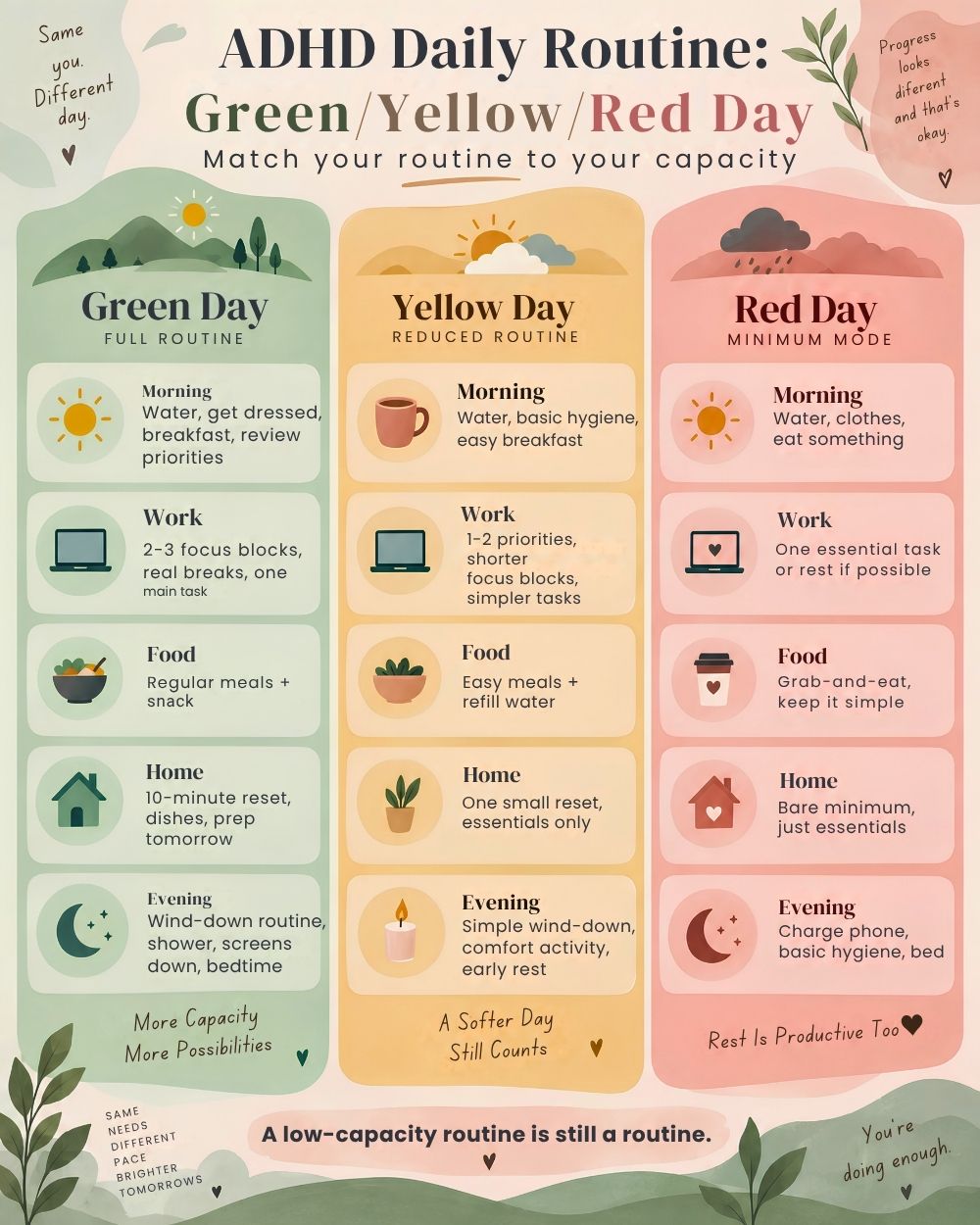
Build Three Versions of Your Routine
Instead of one perfect routine, I would actually make three:
Green Day
You have decent energy.
Do the full routine.
Yellow Day
You are tired or distracted.
Keep the anchors, remove extras.
Red Day
You have very little capacity.
Do only essentials.
For example:
| Anchor | Green | Yellow | Red |
|---|---|---|---|
| Morning | full routine | basics + breakfast | water + clothes + food |
| Work | 3 priorities | 1–2 priorities | one essential task |
| Food | normal meals | easy meals | grab-and-eat |
| Home | reset | one area | essentials only |
| Evening | full wind-down | simple wind-down | bed |
This is much more useful to me than pretending every Tuesday requires the same amount of energy.
How to Make an ADHD Routine Stick
Do not add twelve habits at once.
Start with one anchor.
For example:
After breakfast, I open my task list.
Do that until it becomes familiar.
Then add another.
Also make the environment do some of the remembering.
Use:
- visible baskets;
- items stored where they are used;
- recurring alarms;
- calendar reminders;
- checklists;
- launch pads near the door;
- prepared snacks;
- chargers in fixed places;
- recurring grocery lists.
The less your routine depends on remembering the routine, the better.
Keep Your Routine Visible
A routine hidden inside a notebook you never open is not very useful.
Try:
- printed checklist on the fridge;
- whiteboard;
- phone lock screen;
- desktop wallpaper;
- planner;
- sticky note beside your monitor;
- laminated routine card.
This is also why ADHD routine charts and printable checklists can work well: they move the plan out of your head and into the environment.
What Should Be on an ADHD Routine Chart?
Keep it short.
I would include:
Morning
- water;
- food;
- get ready;
- priorities.
Work
- start;
- break;
- eat;
- reset;
- shutdown.
Evening
- reset;
- tomorrow prep;
- wind down.
And perhaps:
Today I have:
🟢 normal capacity
🟡 reduced capacity
🔴 minimum mode
Then you immediately know which version of your routine you are using.
Common ADHD Routine Mistakes
Making the routine too ambitious
If your routine requires 90 minutes before the actual day begins, it is probably too expensive to maintain.
Adding habits because they sound healthy
A routine should solve your problems.
Not reproduce someone’s YouTube morning routine.
No transition time
Switching activities is part of the schedule.
Build in a few minutes.
No low-energy version
If your routine only works when you feel good, it will repeatedly collapse.
Treating one missed step as failure
You do not need to restart tomorrow.
Restart at the next anchor.
Missed morning?
Use lunch.
Lost afternoon?
Use shutdown.
Bad evening?
Prepare one thing for tomorrow.
The next anchor is always available.
ADHD Routine vs. ADHD Schedule: What’s the Difference?
I think of them like this:
Schedule = when something happens.
Routine = what happens next.
A schedule might say:
Lunch at 12:30.
A routine says:
Eat → refill water → short walk → check remaining priorities.
For ADHD, I often find routines more resilient because they do not completely fall apart when the clock changes.
You can use both.
Just avoid making every routine dependent on perfect timing.
How a Dopamine Menu Fits Into an ADHD Daily Routine
A routine gives you structure.
A dopamine menu gives you choices inside the structure.
For example:
Your schedule says:
10:30 — break.
Your dopamine menu answers:
What kind of break?
Energy?
Calm?
Movement?
Stimulation?
Connection?
That combination is much more useful to me than either system alone.
You can build your own with my Free Dopamine Menu Template or browse 75+ Dopamine Menu Examples.
Start With This ADHD Daily Routine
If the whole article feels like too much, use this:
Morning
Drink → dress → eat → choose one priority.
Start Work
Drink → open file → 10-minute timer.
Midday
Eat → move → reassess.
Finish Work
Write tomorrow’s first task → close everything.
Evening
Reset one area → prepare tomorrow → wind down.
That is enough to start.
You can build everything else later.
Final Thoughts
I do not think the best ADHD routine is the one with the most habits.
I think it is the one that still helps when the day is not going according to plan.
A useful routine gives you:
- fewer decisions;
- clearer transitions;
- predictable anchors;
- an easier way to restart.
You are not trying to automate your entire life.
You are creating a few familiar paths your brain can return to.
And if the routine breaks?
Do not rebuild the entire day.
Just return at the next anchor.