What Is Dopamine Anchoring? A Simple Way to Make Boring Tasks Feel Better
Last updated: September 29, 2026
Some tasks are not difficult.
They are just painfully, unbelievably boring.
Folding laundry. Answering emails. Cleaning the kitchen. Going for a walk when you would rather stay on the couch. Updating a spreadsheet you have already avoided three times today.
This is where dopamine anchoring comes in.
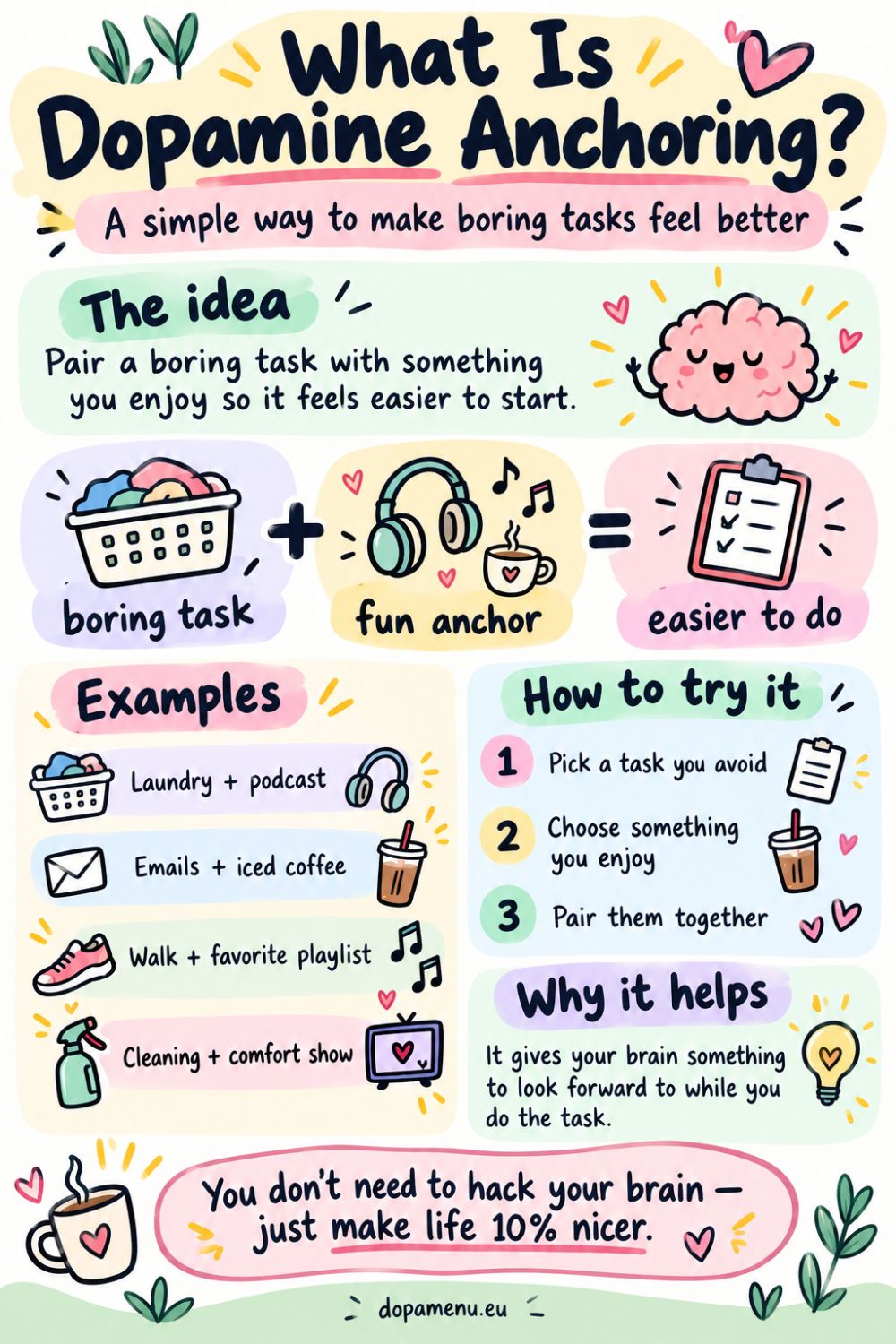
Dopamine anchoring is a simple idea: pair something you need to do with something you genuinely enjoy.
Instead of waiting until the boring task is finished to reward yourself, you bring some of the enjoyment into the task itself.
Think:
- your favorite podcast while cleaning;
- an iced coffee while doing admin;
- a comfort show while folding laundry;
- a great playlist during your morning routine;
- a special snack while working through your inbox.
Nothing revolutionary.
And yet, if your brain constantly asks “but why would I want to do this?”, it can make everyday life surprisingly easier.
What does dopamine anchoring mean?
The term dopamine anchoring is currently being used to describe the practice of attaching an enjoyable stimulus or experience to a task that feels boring, unpleasant or difficult to start.
The enjoyable part becomes an anchor.
Eventually, instead of thinking:
Ugh, I have to clean the kitchen.
you might start thinking:
Oh, this is when I listen to my favorite podcast.
The task itself hasn’t magically become fascinating.
You have simply given your brain something to look forward to while doing it.
Recent lifestyle coverage of the trend describes dopamine anchoring in much the same way: pairing neutral or unpleasant tasks with experiences you enjoy, so there is less friction around getting started. Real Simple
And despite the trendy name, the general idea isn’t entirely new.
Psychology has long studied how rewards, cues and repeated associations can influence motivation and behavior. Dopamine is involved in learning, motivation and reward-related processes, although its role is much more complicated than the internet’s familiar “dopamine = pleasure chemical” explanation suggests. PubMed
So you don’t need to imagine that you’re literally “hacking your dopamine.”
You’re simply making a task more rewarding to approach.
If adding an anchor still doesn’t help you begin, the problem may be closer to executive dysfunction than simple boredom.
I think I’ve been dopamine anchoring long before I knew there was a name for it.
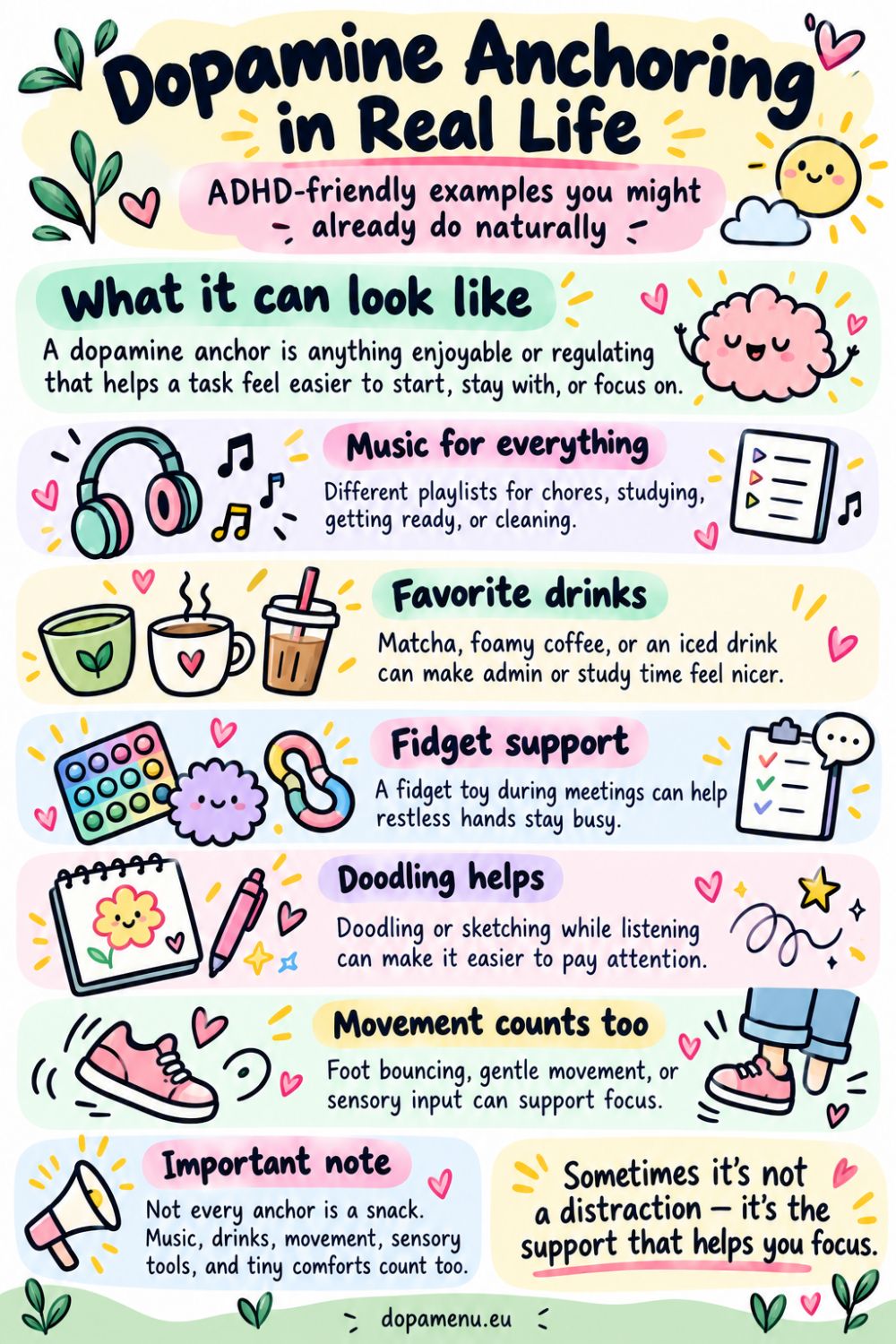
I listen to music for almost everything, and I even have different kinds of music for different tasks — studying, cleaning, getting ready, working. Headphones have always felt like a must-have for me. I also tend to make a favorite drink before I start something, whether that’s matcha, a foamy coffee or something cold. During meetings, I often need a fidget toy in my hand, and if I’m watching a film, having something else to do can actually help me stay focused on it. Looking back, even things like doodling, scribbling in notebooks or moving my legs were probably ways of adding just enough stimulation to keep my attention engaged.
A lot of these behaviors can look like distractions from the outside, especially in school where doodling or fidgeting is often discouraged, but for some brains they can actually be part of what makes focusing possible.
That’s also why I liked this explanation of dopamine anchoring from Upworthy: the article points out that many people may already be using this strategy without realizing it, through environmental, social or sensory anchors.
A very simple dopamine anchoring example
Imagine you hate putting laundry away.
There is nothing particularly challenging about it.
You just never want to start.
Now you decide that one specific podcast is your laundry podcast.
You can listen to other podcasts whenever you want, but this particular one is something you usually save for folding and putting away clothes.
Suddenly:
Laundry → favorite podcast.
The podcast doesn’t remove the laundry.
But it changes the experience surrounding it.
And sometimes that little bit of anticipation is enough to get you moving.
Dopamine anchoring examples
The easiest way to understand dopamine anchoring is to see it in real life.
| Boring thing | Dopamine anchor |
|---|---|
| Cleaning | favorite playlist |
| Folding laundry | comfort TV show |
| Going for a walk | favorite podcast |
| Answering emails | fancy coffee |
| Doing paperwork | special snack |
| Getting ready in the morning | upbeat playlist |
| Grocery shopping | audiobook |
| Meal prep | YouTube video |
| Exercising | show you only watch on the treadmill |
| Budgeting | candle + cozy drink |
| Tidying your room | 15-minute dance playlist |
| Commuting | favorite audiobook |
| Taking a shower | music or shower playlist |
| Weekly planning | coffee shop trip |
| Doing repetitive work | background playlist |
You can make the anchor sensory too.
It doesn’t have to be entertainment.
For example:
boring admin + scented candle
weekly planning + favorite pen
morning routine + really good coffee
cleaning + open windows
work session + cozy lighting
The goal isn’t maximum stimulation.
It’s simply:
What could make this 10% nicer?
That is a very Dopamenu question.
Need more possibilities? Browse my 75+ dopamine menu examples and borrow a few ideas for your own anchors.
Why might dopamine anchoring work?
There is an important distinction here.
Dopamine isn’t simply a chemical your brain releases whenever you are happy.
Research links dopamine to several processes involving motivation, learning, attention, reward prediction and deciding whether something is worth effort. PubMed
One useful way to think about it is anticipation.
Your brain doesn’t only respond once something enjoyable happens.
Signals related to expected rewards can also influence motivation and learning. Research into dopamine and reinforcement learning has studied this relationship extensively. PubMed
That makes the practical principle behind dopamine anchoring pretty intuitive:
Without an anchor
Task → boring → why start?
With an anchor
Task → also means podcast / coffee / music → okay, let’s do it.
Importantly, that does not mean every playlist is causing some giant dopamine spike.
“Dopamine anchoring” is a catchy lifestyle term, not a precise neuroscientific protocol.
I find it more useful as a behavior design idea.
Dopamine anchoring and ADHD
This is where the concept becomes especially interesting.
If you have ADHD, you may recognize the strange experience of being perfectly capable of doing something and still feeling almost physically resistant to starting it.
Especially when the task is:
- repetitive;
- predictable;
- low-interest;
- slow to reward you;
- administratively annoying.
That doesn’t mean dopamine anchoring is an ADHD treatment.
But as a practical strategy, adding interest, novelty, stimulation or immediate enjoyment to a low-interest activity can make some tasks feel more approachable.
And honestly, this is one reason I love the idea.
Instead of constantly asking:
How do I force myself to behave like somebody who enjoys boring routines?
I would rather ask:
How can I design the routine so my brain has something enjoyable in it too?
That subtle shift is basically the philosophy behind Dopamenu.
If boredom and understimulation are what usually stop you in the first place, I also collected 50 things to do when you’re bored with ADHD for different energy levels.
Dopamine anchoring vs. rewarding yourself afterwards
Traditional productivity advice often sounds like this:
Finish the task first. Then you can have the reward.
Sometimes that works.
But if the reward is 45 minutes away and your brain doesn’t even want to begin, it isn’t always very motivating.
Dopamine anchoring changes the timing.
Instead of:
boring thing → boring thing → boring thing → reward
you get:
boring thing + enjoyable thing
The reward becomes part of the experience.
That is why a treadmill show can work better than promising yourself Netflix after the workout.
The Netflix is helping you cross the starting line.
How to try dopamine anchoring
Don’t over-engineer this.
Pick one task you regularly avoid.
Then ask yourself three questions:
1. What part of this task do I dislike?
Is it boring?
Lonely?
Repetitive?
Slow?
Mentally draining?
2. What do I naturally look forward to?
Maybe:
- music;
- coffee;
- podcasts;
- audiobooks;
- crunchy snacks;
- candles;
- TV;
- being outside;
- calling someone;
- sitting somewhere cozy.
3. Can I pair the two?
That’s your anchor.
For example:
I hate sorting receipts.
I love sitting in my favorite café.
=
Receipt-sorting café hour.
You have essentially given an annoying task a new context.
10 dopamine anchoring ideas to try today
If you want some very easy starting points:
- Save a favorite podcast for your daily walk.
- Put on one specific playlist whenever you clean.
- Drink your favorite coffee while doing weekly planning.
- Watch a comfort show while folding clothes.
- Listen to an audiobook while grocery shopping.
- Light a candle before starting admin work.
- Keep a special snack for long computer tasks.
- Call a friend while doing a repetitive household task.
- Work from a café when you have something especially boring to finish.
- Turn errands into a mini outing with a fun stop afterwards.
The best anchor isn’t necessarily the most exciting one.
It is the one that actually makes you think:
Fine. I could do that.
A small warning: don’t anchor everything
This is where I wouldn’t take the trend too literally.
You don’t need constant entertainment.
And you don’t need to turn every quiet moment into music + podcast + snack + TikTok + coffee + three screens.
Sometimes boredom is fine.
Sometimes quiet is good.
And some activities need enough concentration that adding stimulation actually makes them harder.
The goal isn’t to maximize dopamine.
The goal is to strategically make a few friction-heavy parts of your life easier and more enjoyable.
Dopamine anchoring vs. a dopamine menu
They’re related, but I would think about them slightly differently.
A dopamine menu is a collection of activities you know you enjoy or find stimulating.
A dopamine anchor takes one of those enjoyable things and attaches it to something you need or want to do.
For example, your dopamine menu might include:
- coffee;
- a walk;
- music;
- podcasts;
- drawing;
- calling a friend.
Then you could turn some of those into anchors:
podcast + cleaning
coffee + planning
friend call + walking
music + getting ready
Your dopamine menu is essentially your library of enjoyable ingredients.
Dopamine anchoring is one way to use them.
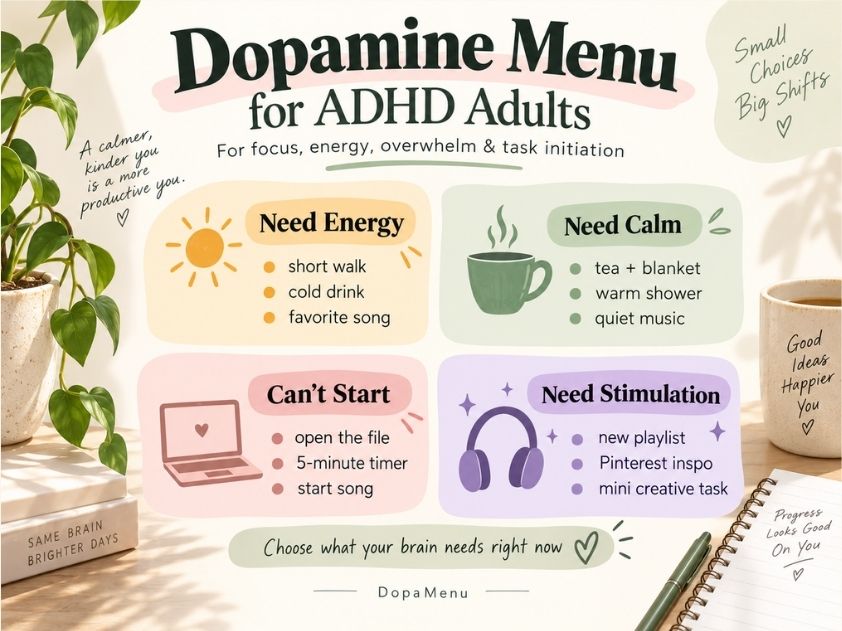
A dopamine menu for ADHD adults can be a useful place to collect possible anchors — music, drinks, movement, creative activities and other things you already know your brain enjoys.
My favorite way to think about dopamine anchoring
I don’t think we need another productivity trend that tells us how to optimize every molecule in our brain.
What I like about dopamine anchoring is much simpler.
It asks:
Why does the boring thing have to stay boring?
Sometimes we can’t remove the tedious parts of adulthood.
There will still be emails.
Laundry will somehow regenerate.
Someone will always need to empty the dishwasher.
But you are allowed to add things you enjoy to ordinary life.
A playlist.
An unnecessarily good coffee.
A podcast.
A ridiculous little treat.
A candle at 2 PM for absolutely no reason.
Maybe that isn’t a dopamine hack.
Maybe it’s just making life nicer on purpose.
And honestly, I’m happy with that.
Quick FAQ
What is dopamine anchoring?
Dopamine anchoring is a popular term for pairing a task you find boring or unpleasant with something you enjoy, such as music, a podcast, coffee or a favorite show.
What is an example of dopamine anchoring?
Listening to a favorite podcast only while cleaning is a simple example. The enjoyable podcast becomes associated with the otherwise boring task.
Is dopamine anchoring scientifically proven?
“Dopamine anchoring” itself is a lifestyle term rather than an established clinical treatment or formal neuroscience technique. However, the broader ideas behind it overlap with well-established research into rewards, motivation, conditioning and reinforcement learning. Dopamine is involved in several of these processes, but its function is much more complex than simply producing pleasure. PubMed
Can dopamine anchoring help with ADHD?
Some people with ADHD may find that adding immediate interest or enjoyment makes boring tasks easier to approach. It should be treated as a practical strategy rather than a treatment for ADHD.
Do I need to use the same anchor every time?
No. You can experiment. Some people may enjoy creating a strong association—such as one podcast reserved for walking—while others may prefer changing the anchor regularly to keep things interesting.