50 Things to Do When You’re Bored With ADHD
Last updated: September 29, 2026
There is bored.
And then there is ADHD bored.
The kind where you have approximately 47 possible things you could do, but somehow none of them sound interesting enough to begin.
You might scroll your phone while simultaneously being bored by your phone. Open the fridge without being hungry. Walk into another room. Forget why. Consider starting a new hobby. Decide that would require supplies. Sit back down.
Very productive afternoon.
Boredom and understimulation can feel particularly uncomfortable for people with ADHD. Adults with ADHD may have more difficulty staying engaged with repetitive or low-interest tasks and may seek extra stimulation through novelty, movement, music, fidgeting or other sensory input. ADDA
But when you’re already bored, the worst possible advice might be:
“Just find something fun to do.”
Thanks.
The hard part is often deciding what that something is.
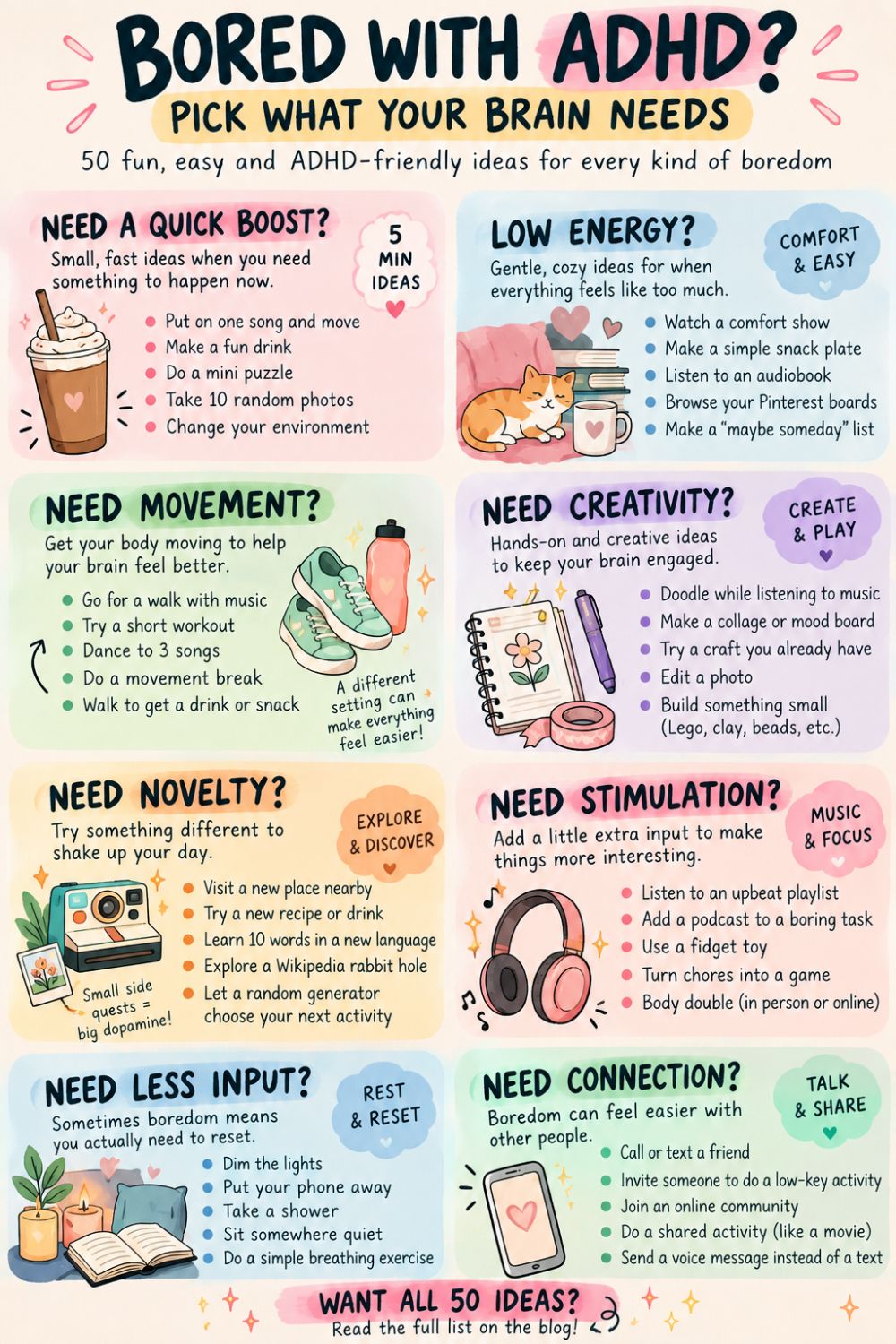
So instead of one giant random list, here are 50 things to do when you’re bored with ADHD — organized by what your brain might actually be asking for.
First: are you bored, or are you understimulated?
They can overlap, but I find this distinction useful.
Boredom is basically:
“This isn’t interesting.”
Understimulation can feel more like:
“My brain needs something, but I can’t figure out what.”
It might show up as:
- restlessness;
- constantly switching apps;
- wanting background noise;
- feeling unable to start anything;
- fidgeting;
- looking for snacks without really being hungry;
- wanting novelty;
- feeling strangely tired despite not doing much.
ADDA notes that understimulation in ADHD may involve difficulty concentrating on uninteresting tasks, restlessness, low motivation and seeking additional stimulation such as music, movement or fidgeting. ADDA
You don’t necessarily need a gigantic exciting activity.
Sometimes your brain just needs a slightly better level of stimulation.
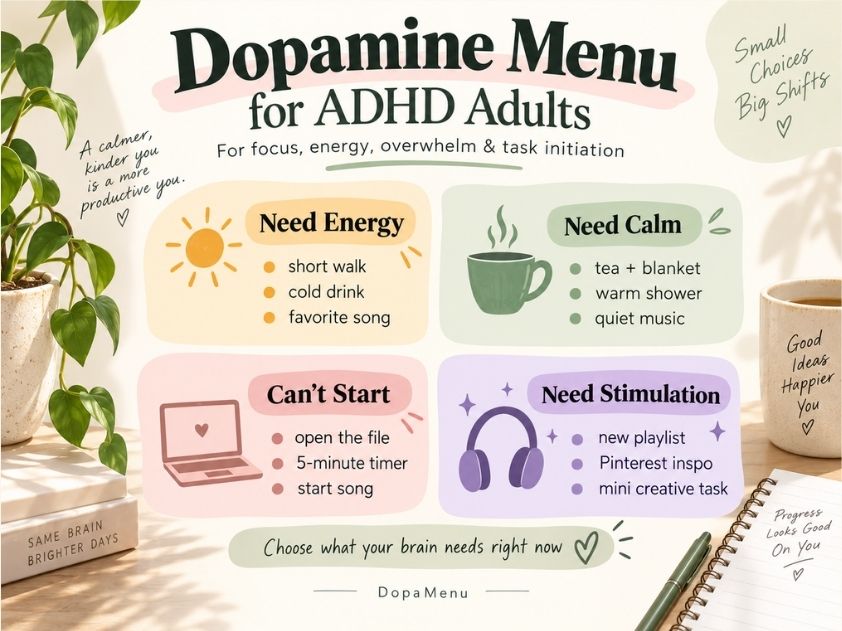
If you regularly end up in the “I’m bored but I can’t think of anything” state, creating an ADHD-friendly dopamine menu can save you from having to invent ideas on the spot.
If you need something QUICK
These are for the:
“I need something to happen in the next five minutes.”
moments.
1. Put on one song and move until it ends
Dance badly.
Walk around.
Stretch.
Clean something.
The song gives the activity a beginning and an end.
2. Make an unnecessarily nice drink
Matcha.
Foamy coffee.
Iced tea.
Sparkling water in your favorite glass.
This is one of my personal defaults. Sometimes the activity isn’t even the important part — preparing something I genuinely enjoy is enough to make the next thing feel slightly more appealing.
3. Take a different route around your neighborhood
Novelty doesn’t have to mean booking a flight.
Turn left where you normally turn right.
4. Do one tiny puzzle
Sudoku, Wordle, a crossword, a mini logic puzzle.
Something with a clear finish line.
5. Rearrange one tiny area
Not:
organize your entire home.
Try:
one drawer.
one shelf.
your desk.
your bag.
Sometimes boredom isn’t the only problem — starting can feel impossible too. Here’s the difference between executive dysfunction and laziness.
6. Find a song you forgot existed
Open an old playlist.
Go back to whatever you listened to at 17.
Instant time travel.
7. Take 10 photos of ordinary things
A shadow.
Your coffee.
Something red.
A weird texture.
Give yourself a ridiculous theme.
8. Go outside for exactly ten minutes
No exercise goal required.
Just change the environment.
9. Try a five-minute doodle
You don’t need to be good at drawing.
Draw flowers.
Random shapes.
Tiny houses.
Whatever your hand wants to do.
10. Change your physical position
Floor.
Balcony.
Couch.
Standing desk.
Coffee shop.
Sometimes your brain isn’t asking for a new activity.
It wants a new setting.
If you’re bored but have ZERO energy
This is a completely different situation.
You do not need:
“Start a pottery business!”
You need something that asks almost nothing of you.
11. Make a comfort drink
Yes, drinks appear twice.
I stand by this.
12. Watch one episode of something familiar
Sometimes novelty is great.
Sometimes predictability is exactly what your brain wants.
13. Make a very low-effort snack plate
Cheese.
Fruit.
Crackers.
Nuts.
Whatever requires almost no decisions.
14. Listen to an audiobook with your eyes closed
Entertainment without visual input.
15. Lie down and listen to an album from beginning to end
Not shuffle.
An actual album.
Old-fashioned, I know.
16. Browse your saved Pinterest boards
Not endless algorithm scrolling.
Go back to the things you deliberately saved because you liked them.
17. Make a “maybe someday” list
Not a to-do list.
Much more fun.
Things you’d like to:
- learn;
- visit;
- cook;
- buy;
- make;
- try.
18. Put on something cozy
Sometimes changing the sensory situation is the activity.
19. Watch a relaxing hobby video
Painting.
Cooking.
Miniatures.
Restoration.
Gardening.
Whatever scratches the someone is making something itch.
20. Make a tiny dopamine menu
Write down:
3 things that sound okay right now.
Not amazing.
Not life-changing.
Just okay.
Pick one.
If you need MOVEMENT
Sometimes my brain says:
“I’m bored.”
when my body actually says:
“Please stop making me sit here.”
Movement can be one way to add stimulation, and exercise or simple physical activity is commonly suggested among strategies for ADHD boredom and understimulation. Psych Central
21. Walk while listening to a podcast
Classic for a reason.
22. Put on three songs and clean until they finish
No need to “finish cleaning.”
When the playlist ends, you’re done.
23. Stretch while watching YouTube
It still counts.
24. Learn 30 seconds of a dance
You absolutely do not need to post it anywhere.
25. Walk somewhere to get a drink
Give the walk a mission.
26. Try a new workout
Not necessarily a serious one.
Five-minute Pilates.
Mobility.
Dance cardio.
Yoga.
27. Do a “random movement break”
Ten squats.
Walk upstairs.
Stretch your shoulders.
Shake your arms.
Move on.
28. Take your phone call outside
Walking + talking can make both more interesting.
29. Throw or bounce something
A ball.
A balloon.
Anything that won’t destroy your home.
30. Put on headphones and pace
I genuinely think headphones deserve their own category of assistive life equipment.
If you need something CREATIVE
One of my favorite ways to deal with boredom is giving my hands something to do.
Especially when it uses hands + brain at the same time.
31. Doodle while listening to something
I did versions of this as a kid too.
Ironically, doodling and fidgeting often get treated as evidence that someone isn’t paying attention, while some people find that a low-level secondary activity actually helps them stay engaged. ADDA includes doodling and unobtrusive fidgeting among examples of added stimulation people with ADHD may find useful. ADDA
Another strategy I use constantly is dopamine anchoring — adding something enjoyable like music, a drink or a fidget to an otherwise boring activity.
32. Make a collage
Digital or physical.
Pinterest + Canva counts.
33. Try a craft you already own supplies for
This rule matters.
Otherwise:
bored → new hobby → €80 shopping cart.
Ask me how I know.
34. Make something tiny
Tiny drawing.
Tiny bracelet.
Tiny collage.
Tiny Lego build.
Small projects create faster payoff.
35. Redesign something completely unnecessary
Your phone home screen.
Spotify cover.
Notebook.
Desktop.
36. Take one ordinary photo and edit it beautifully
Give yourself a mini creative brief.
37. Make a mood board
For:
autumn.
your bedroom.
your dream weekend.
your next version of yourself.
38. Write a ridiculous list
For example:
Things I would buy if I suddenly owned a castle.
Creativity does not have to be useful.
39. Make a themed playlist
Examples:
cleaning like I’m in a movie montage
main character grocery shopping
emails but make it dramatic
40. Build something with your hands
Lego.
Clay.
Beads.
Paper.
Anything tactile.
If you need NOVELTY
Sometimes you don’t need to relax.
You need a tiny side quest.
41. Visit somewhere you’ve never been in your own city
A café.
Bookstore.
Park.
Shop.
Street.
42. Order something you’ve never tried from a familiar place
Maximum novelty.
Minimum logistical effort.
43. Learn one useless skill
Shuffle cards.
Fold a paper crane.
Spin a pen.
Identify three constellations.
44. Pick a random recipe and make it
Bonus points if you’ve never eaten it before.
45. Try a “$0 side quest”
Examples:
find the weirdest building nearby.
photograph five yellow things.
find the best tree in the neighborhood.
46. Explore a Wikipedia rabbit hole
Deliberately.
Choose a subject and follow links until you reach something completely unrelated.
47. Learn ten words in a new language
Not:
learn Spanish.
Ten words.
48. Switch locations for one ordinary activity
Read at a café.
Eat lunch outside.
Work at the library.
Drink coffee on the floor.
Novelty can be incredibly small.
49. Let a random generator choose something
Movie.
Recipe.
Activity.
Number.
Decision fatigue solved.
If having too many choices is the problem, read my guide to decision fatigue and ADHD for ways to make the next decision smaller.
50. Give yourself a dopamine side quest
This may be my favorite.
A dopamine side quest is simply:
a small unnecessary adventure whose only purpose is making the day more interesting.
Buy one unusual fruit.
Walk to a street you’ve never seen.
Try a new drink.
Visit a thrift shop with a €5 challenge.
Photograph five weird doors.
Life doesn’t always need another productivity goal.
Sometimes it needs plot.
What if absolutely nothing sounds fun?
This is the frustrating part.
Sometimes you’re bored, but every suggestion sounds terrible.
That’s when I wouldn’t search for:
the perfect thing I want to do.
I’d lower the standard to:
what sounds least annoying?
There is a huge difference.
Instead of choosing between 50 activities, choose between:
movement
sensory
creative
social
novelty
rest
Pick the category first.
Then the activity.
You’re reducing the number of decisions your brain has to make.
My personal boredom rule: add stimulation before abandoning the activity
This is something I’ve slowly realized about myself.
I naturally add stimulation to almost everything.
Music is probably the biggest one.
I don’t simply listen to music.
I have different music for different types of activities.
Cleaning music.
Working music.
Getting-ready music.
Studying music.
Headphones have basically always been a must-have.
I also make favorite drinks — matcha, foamy coffee, iced drinks — when I’m settling down to do something.
During meetings, I’m much happier if I have a fidget toy.
And sometimes if I’m watching a movie, doing something small with my hands actually makes it easier for me to stay with the movie rather than harder.
Looking back, I did versions of this as a child too.
Doodling.
Scribbling.
Moving my legs.
Adding stimulation wherever I could.
A lot of those things can look like distraction from the outside.
But now I’m much more interested in asking:
Is this distracting me — or is it giving my brain enough stimulation to stay here?
That distinction has been surprisingly useful.
Try this before deciding you’re bored
If an activity feels unbearably dull, don’t immediately abandon it.
Try adding one layer.
For example:
laundry + podcast
walking + music
emails + iced coffee
meeting + fidget
planning + café
cooking + audiobook
cleaning + timer
movie + doodling
This is basically the idea behind dopamine anchoring: pairing a low-interest activity with something enjoyable or stimulating.
And once I learned there was a name for this, I realized I’d been doing versions of it for years.
Bored or overstimulated?
One final thing.
More stimulation isn’t always the answer.
ADHD can also be associated with sensory difficulties and overstimulation. Psych Central
Sometimes:
“Nothing sounds fun.”
doesn’t mean:
“I need MORE.”
It means:
“I need LESS.”
If music suddenly feels irritating, your phone feels exhausting and every suggestion on this list annoys you, try going the opposite direction:
dim the lights.
put your phone away.
drink something.
take a shower.
lie somewhere quiet.
go outside.
You aren’t trying to hit some imaginary perfect dopamine level.
You’re figuring out what kind of input your brain wants right now.
And unfortunately, brains do not come with a dashboard.
So sometimes we experiment.
Save this: choose by what you need
When you have no idea what to do:
Need energy? → Move.
Need novelty? → Side quest.
Need comfort? → Familiar activity.
Need stimulation? → Music / sensory / creative.
Need focus? → Add an anchor.
Need less input? → Reduce stimulation.
Need connection? → Call or meet someone.
Can’t decide? → Pick the easiest thing on the list.
That’s enough.
You do not have to turn boredom into productivity.
Sometimes the goal is simply to make the next half hour more interesting to live through.
And I think that’s a perfectly valid use of a Tuesday afternoon.
FAQ
What can someone with ADHD do when they’re bored?
Activities involving novelty, movement, creativity, sensory stimulation or an immediate reward may feel easier to engage with when you’re bored. Examples include walking while listening to music, doing a short creative project, trying a new activity, using a fidget or turning an ordinary task into a mini-game. ADDA
Why does boredom feel so uncomfortable with ADHD?
Research and clinical resources describe greater difficulties with boredom and understimulation among some people with ADHD. Low-interest or repetitive activities may be harder to sustain attention on, while novelty, interest and immediate rewards can make engagement easier. ADDA
What should I do when I’m understimulated with ADHD?
Try changing the type or amount of stimulation rather than automatically looking for a completely new activity. Music, movement, fidgeting, novelty, a change of environment, body doubling or turning an activity into a game may help some people. ADDA
What if I’m bored but don’t want to do anything?
Start smaller. Instead of asking what sounds exciting, ask what sounds least difficult. Try a five-minute activity, change environments, make a drink, put on music or choose one category — movement, comfort, creativity, novelty or rest — before choosing a specific activity.