Dopamine Foods List: 50 Foods for Focus, Energy & ADHD-Friendly Eating
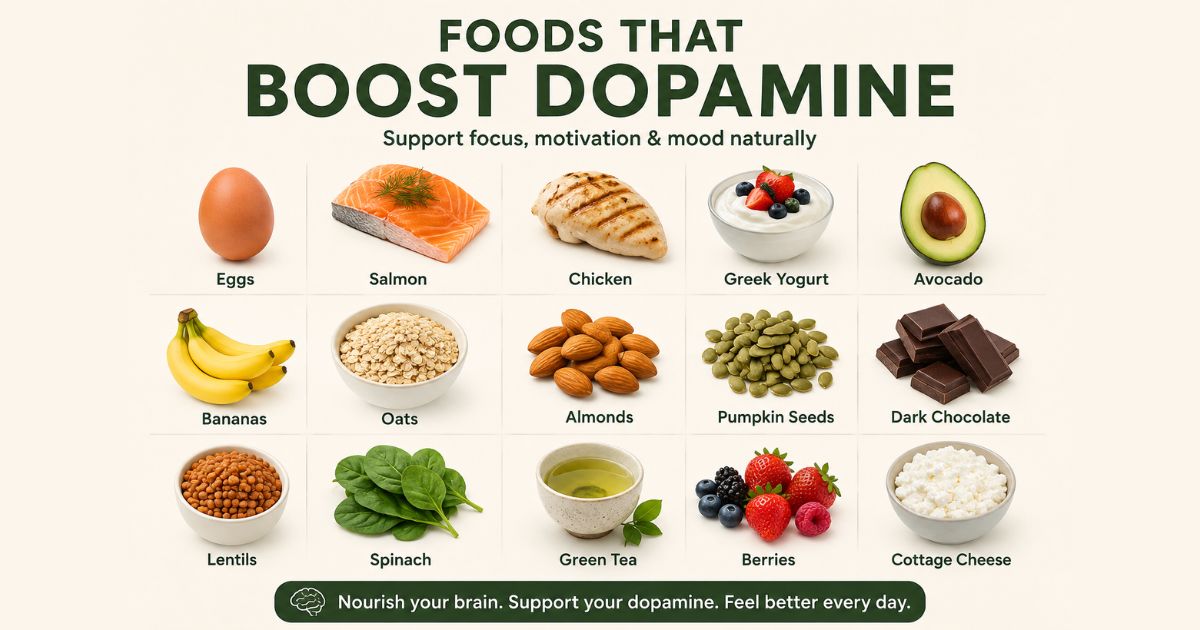
If you’re looking for foods that support dopamine production, start with protein-rich foods such as eggs, salmon, chicken, turkey, Greek yogurt, tofu, lentils, beans, nuts and seeds.
These foods provide nutrients your body uses in normal brain function, including protein and tyrosine, an amino acid involved in the pathway your body uses to make dopamine.
Other easy options include bananas, avocado, oats, berries, pumpkin seeds and dark chocolate.
But there is an important distinction:
Food doesn’t work like a dopamine switch.
Eating one specific food will not suddenly “fix” low motivation, improve ADHD symptoms or create a predictable dopamine boost in your brain. Dopamine biology is much more complicated than that.
For me, this topic became interesting for a slightly different reason.
I started wondering why I can completely forget to eat when I am absorbed in something — and then suddenly want the easiest, crunchiest or most satisfying snack I can find.
That sent me down a rabbit hole about food, dopamine, reward, ADHD-style eating patterns and why feeding yourself can become surprisingly difficult when your brain is already overloaded.
And because apparently I cannot become curious about something without eventually turning it into a blog, here we are. 😄
This guide is the practical result: 50 dopamine-supporting foods, easy ADHD-friendly combinations and realistic meal ideas for days when your brain has very little capacity left.
Important: I am not a doctor or dietitian. Food cannot diagnose or treat ADHD, clinically low dopamine or another medical condition. I use established medical and scientific sources when discussing brain health and nutrition, and keep the focus here on practical everyday support.
Quick Answer: What Are the Best Dopamine Foods?
If you just want the short version, some of the most practical foods associated with normal dopamine production include:
- eggs;
- salmon;
- chicken and turkey;
- Greek yogurt;
- cottage cheese;
- lentils and beans;
- tofu and tempeh;
- pumpkin seeds;
- almonds and peanuts;
- bananas;
- avocado;
- oats;
- berries;
- dark chocolate.
Many of these foods contain protein and amino acids such as tyrosine.
Tyrosine is a precursor used in the biological pathway that produces catecholamines including dopamine and norepinephrine. However, the relationship between dietary tyrosine and dopamine activity in the brain is complex, and simply eating more tyrosine does not guarantee noticeably higher dopamine, better concentration or more motivation.
For everyday eating, I think there is a much more useful question:
Which foods are easy enough that I will actually eat them?
That is especially important when executive function, energy or decision-making is already running low.
Top 10 Dopamine-Supporting Foods
If 50 foods sound like another list you are supposed to memorize, don’t.
Start here.
| Food | What it provides | Easy way to eat it |
|---|---|---|
| Eggs | Protein and tyrosine | Egg toast |
| Salmon | Protein and omega-3 fats | Salmon rice bowl |
| Greek yogurt | Protein and calcium | Yogurt + berries |
| Turkey | Protein and tyrosine | Turkey wrap |
| Lentils | Protein, iron and fiber | Lentil soup |
| Pumpkin seeds | Protein, magnesium and iron | Sprinkle on oatmeal |
| Almonds | Protein and unsaturated fats | Apple + almonds |
| Banana | Carbohydrates and vitamin B6 | Banana smoothie |
| Avocado | Fiber and unsaturated fats | Avocado toast |
| Dark chocolate | An enjoyable, easy food | A few squares after lunch |
Get the Free Dopamine Foods List + 7-Day ADHD-Friendly Meal Plan
50-food checklist + easy low-energy meals and snacks, sent straight to your inbox.
My easiest ADHD-friendly formula
When deciding what to eat feels like too much work, I usually find combinations more useful than recipes.
Try:
one protein + one easy carbohydrate or fruit + something enjoyable
For example:
- Greek yogurt + banana + nuts;
- apple + peanut butter;
- toast + egg + avocado;
- crackers + cheese + grapes;
- hummus + pita or crackers;
- popcorn + cheese + fruit.
The goal is not nutritional perfection.
The goal is making the next eating decision easier.
Get the Free Dopamine Foods List + 7-Day Meal Plan
If you know you will not remember 50 foods after closing this tab, I made something easier.
The free printable includes:
- a 50-food shopping checklist;
- seven days of easy meals and snacks;
- low-energy and no-cook options;
- a flexible ADHD-friendly meal structure.
Get the Free Dopamine Foods List + 7-Day Meal Plan →
You’ll also receive supportive Dopamenu emails. Unsubscribe anytime.
What Are “Dopamine Foods”?
“Dopamine foods,” “dopamine-rich foods” and “dopamine boosting foods” are popular search terms.
They are also slightly misleading.
Dopamine is a neurotransmitter involved in functions including movement, motivation, attention, learning and reward.
Your body makes dopamine through a series of biological steps.
One of the substances involved in this process is tyrosine, an amino acid that can be obtained from protein-containing foods.
So when I use the phrase dopamine-supporting foods, I am not saying that eating an egg or a banana delivers a packet of dopamine straight into your brain.
I mean foods that can contribute protein, amino acids and other nutrients within an overall balanced diet.
Useful nutrients and food components include:
- protein;
- tyrosine;
- omega-3 fatty acids;
- iron;
- magnesium;
- B vitamins;
- carbohydrates;
- fiber;
- a range of vitamins and minerals.
Tyrosine availability can influence catecholamine synthesis under some circumstances, but nutrient intake, amino-acid transport across the blood-brain barrier and brain neurotransmission interact in complicated ways.
In other words:
normal food matters, but there is no magic dopamine ingredient.
And honestly, I find that more useful than another restrictive wellness rule anyway.
Don’t Try to Buy All 50 Foods
If you have ADHD-style all-or-nothing tendencies, a list titled “50 foods” can very quickly become:
Apparently I need to replace the entire contents of my refrigerator.
You don’t.
Pick five:
- one protein you already like;
- one easy fruit;
- one crunchy option;
- one no-cook food;
- one comforting food.
For example:
Greek yogurt + banana + popcorn + hummus + chocolate.
That already gives you several possible combinations without creating another complicated system you have to maintain.

Why Eating Can Feel Surprisingly Difficult With ADHD
This is the part that originally made me curious about the whole topic.
Sometimes I can become completely absorbed in work and barely notice that I am hungry.
Then I cross an invisible line.
Suddenly I am very hungry, my brain has even less patience for decisions, cooking feels ridiculous, and I want whatever is fastest and most satisfying.
If you relate, you might also recognize things like:
- forgetting to eat while hyperfocusing;
- not noticing hunger until it feels urgent;
- buying ingredients and forgetting they exist;
- opening the fridge repeatedly without deciding what to eat;
- wanting a snack even though making a meal would probably be more satisfying;
- craving texture, crunch or novelty;
- relying on whatever requires the fewest steps;
- skipping food because preparing it feels like one task too many.
None of these automatically means ADHD, and ADHD does not mean everyone eats in the same way.
But research does suggest that reward processing and decision-making can differ in adults with ADHD, and dopamine has an important role in motivational and feeding-related systems.
Recent research has also continued exploring relationships between ADHD traits and patterns such as uncontrolled, emotional or disordered eating, although these relationships are complicated and should not be reduced to “ADHD causes snacking.”
For me, that distinction is important.
I am not trying to diagnose every trip to the snack cupboard.
I am trying to understand:
What makes eating easier for a brain that sometimes forgets, avoids, delays, seeks stimulation or gets overwhelmed by decisions?
And that is a question we can actually build practical systems around.

Regular Eating May Be More Useful Than Chasing a “Dopamine Diet”
There is no special dopamine diet required for ADHD.
General NHS guidance for adults with ADHD recommends a healthy balanced diet and regular mealtimes rather than a specific restrictive ADHD diet.
That sounds almost boring.
But boring systems can be incredibly useful.
Instead of asking:
“What is the perfect thing to eat for dopamine?”
I find it more practical to ask:
- What food will I actually remember exists?
- What can I eat in two minutes?
- What can live in my bag?
- What can I eat when cooking feels impossible?
- What foods do I reliably enjoy?
- What combinations keep me from reaching the “I am starving and cannot think” stage?
That is what ADHD-friendly eating means to me.
Not perfect nutrition.
Less friction.
Dopamine Foods by Category
High-Protein Foods
Eggs · chicken · turkey · salmon · tuna · Greek yogurt · cottage cheese · tofu · tempeh · lentils · beans · edamame
Nuts and Seeds
Pumpkin seeds · almonds · peanuts · walnuts · sesame seeds · sunflower seeds · chia seeds · flaxseeds
Easy Fruits
Bananas · berries · oranges · kiwi · apples · mango · grapes · pineapple · watermelon
Vegetables
Spinach · kale · broccoli · Brussels sprouts · sweet potatoes · beets · carrots · peas · tomatoes
Easy ADHD Staples
Greek yogurt · eggs · cheese · protein bars · canned tuna · microwave rice · frozen fruit · frozen vegetables · bread · wraps · popcorn
These last foods are not here because they are biologically superior.
They are here because convenience is a feature.
A nutritious food hidden behind six preparation steps is not always more useful than a reasonably balanced food you can eat immediately.

Complete Dopamine Foods List: 50 Ideas
Use this as inspiration for grocery shopping, meal planning or creating your own short list of reliable foods.
High-Protein Foods
Protein foods provide amino acids, including tyrosine.
- Eggs
- Chicken
- Turkey
- Salmon
- Tuna
- Greek yogurt
- Cottage cheese
- Tofu
- Tempeh
- Edamame
- Lentils
- Chickpeas
- Black beans
- Quinoa
- Protein powder
Foods High in Tyrosine
Tyrosine is an amino acid involved in the pathway used to make dopamine and norepinephrine.
Some practical protein-rich sources include:
| Food | Why it fits |
|---|---|
| Chicken | Protein + tyrosine |
| Turkey | Protein + tyrosine |
| Eggs | Protein + essential amino acids |
| Salmon | Protein + omega-3 fats |
| Greek yogurt | Easy high-protein food |
| Tofu | Plant-based protein |
| Edamame | Easy plant protein |
| Lentils | Protein + iron |
| Pumpkin seeds | Protein + magnesium |
| Peanuts | Protein + unsaturated fats |
It is still worth repeating: eating more tyrosine is not the same thing as predictably “boosting dopamine.”
Research on tyrosine supplementation has found some potential cognitive effects particularly under demanding or stressful conditions, but this should not be translated into the claim that ordinary foods act like ADHD treatment or dopamine medication.
Nuts, Seeds and Healthy Fats
- Pumpkin seeds
- Sesame seeds
- Almonds
- Peanuts
- Walnuts
- Sunflower seeds
- Chia seeds
- Flaxseeds
- Avocado
- Olive oil
These are easy additions to foods you may already eat.
Try:
- nuts + fruit;
- pumpkin seeds on yogurt;
- peanut butter on toast;
- avocado on bread;
- olive oil added to rice, vegetables or soup.
Easy Fruits
- Bananas
- Blueberries
- Strawberries
- Oranges
- Kiwi
- Apples
- Mango
- Grapes
- Pineapple
- Watermelon
Fruit is one of my favorite examples of an ADHD-friendly food category because many options require almost no preparation.
Sometimes “easy enough to eat now” wins.
Vegetables
- Spinach
- Kale
- Broccoli
- Brussels sprouts
- Sweet potatoes
- Beets
- Carrots
- Peas
- Collard greens
- Tomatoes
Frozen vegetables absolutely count.
Pre-cut vegetables count.
Vegetables added to something convenient count.
You do not receive bonus points for making your life unnecessarily difficult.
Enjoyable Extras
- Dark chocolate
- Matcha
- Honey
- Cocoa
- Popcorn with nutritional yeast
I deliberately include enjoyable foods.
Eating is not only a nutrient-delivery task.
Taste, texture, comfort, novelty and pleasure matter too.
Best Dopamine Foods for ADHD-Friendly Eating
If I had to choose foods specifically for an ADHD-friendly kitchen, I would not rank them only by nutrient density.
I would also ask:
Can I actually use this food when my executive function is low?
My most useful foods tend to be:
- visible;
- quick;
- satisfying;
- easy to combine;
- available when energy is low;
- forgiving if plans change;
- realistic for my budget;
- foods I genuinely enjoy.
Useful staples might include:
- eggs;
- Greek yogurt;
- cheese;
- canned tuna;
- tofu;
- lentils;
- nuts;
- bananas;
- apples;
- oats;
- frozen fruit;
- frozen vegetables;
- bread;
- wraps;
- microwave rice;
- popcorn.
Make food easier to notice
One thing I find particularly useful is changing the environment instead of expecting my memory to suddenly become excellent.
For example:
- keep a snack basket where you work;
- put yogurt at the front of the refrigerator;
- keep a protein bar in your bag;
- freeze bread instead of repeatedly throwing it away;
- keep one emergency meal available;
- store foods where you actually see them.
Sometimes the solution is not more discipline.
Sometimes the banana simply needs to stop living behind three other things.
If texture helps make food more appealing, try these high-protein crunchy snacks for ADHD-friendly eating — they combine easy protein sources with satisfying, low-effort crunch.
What Foods Increase Dopamine Naturally?
This is one of the most common questions around dopamine foods.
The accurate answer is less dramatic than many social media posts suggest.
Foods do not directly increase brain dopamine in a simple, predictable way.
The brain synthesizes dopamine through biological pathways involving precursor molecules including tyrosine, and dietary intake can influence precursor availability. But neurotransmitter synthesis also depends on transport, metabolism, competing amino acids, neuronal activity and many other factors.
So I would not think about food as:
Eat banana → receive dopamine.
A better model is:
Eat a varied diet → provide your body with the protein, energy, micronutrients and other materials it needs for normal functioning.
Much less exciting.
Much more defensible.
Choose Food Based on Your Available Energy
This might be my favorite way to plan food.
Instead of pretending I have the same amount of capacity every day, I choose from different effort levels.
| When you have… | Try… |
|---|---|
| Almost no energy | Protein bar, banana, yogurt, cheese + crackers |
| Two minutes | Toast + peanut butter, yogurt + granola |
| Five minutes | Eggs on toast, smoothie, hummus snack plate |
| A little more capacity | Salmon rice bowl, tofu noodles, lentil soup |
These are not strict meal categories.
They are decision shortcuts.
And on low-capacity days, I would rather eat an imperfect easy meal than wait three hours for the imaginary version of myself who suddenly wants to cook something elaborate.
Easy Dopamine-Friendly Snack Combinations
When I do not want to cook, combining two foods is usually easier than inventing a “meal.”
Try:
- banana + peanut butter;
- Greek yogurt + berries;
- apple + almonds;
- cottage cheese + grapes;
- crackers + cheese;
- toast + egg;
- hummus + carrots;
- popcorn + nuts;
- smoothie + protein powder;
- rice cakes + almond butter;
- dark chocolate + strawberries;
- yogurt + banana + granola.
If the texture matters to you, you may also enjoy having a crunchy option available.
For more ideas:
- Healthy Snack Combos for Steady Energy
- High-Protein Crunchy Snacks
- ADHD Snack Plates: Easy No-Prep Ideas
Simple Meals for Low-Energy ADHD Days
I think low-energy food deserves its own category.
These are not “lazy meals.”
They are meals designed for days when there is less capacity available.
Breakfast
- Greek yogurt + banana + nuts;
- avocado toast + egg;
- protein smoothie + frozen fruit;
- oatmeal + peanut butter;
- cottage cheese + fruit + toast.
Lunch
- turkey and cheese wrap;
- tuna + crackers + cucumber;
- hummus snack plate;
- microwave rice + edamame + sauce;
- lentil soup + bread.
Dinner
- salmon + microwave rice + frozen vegetables;
- tofu noodles + frozen vegetables;
- chickpea curry + rice;
- egg fried rice + peas;
- loaded toast with eggs, avocado or beans.
And yes:
Convenience food counts.
Frozen food counts.
Pre-cut food counts.
Eating the same meal three times in a week counts.
The goal is not auditioning for a cooking show.
The goal is feeding yourself.
What to Eat When You Forget to Eat
One of my own recurring problems is not necessarily choosing the “wrong” food.
Sometimes I simply forget food exists until I am already exhausted and hungry.
If this happens to you too, start with something requiring almost no effort:
- yogurt;
- banana;
- toast;
- cheese + crackers;
- protein bar;
- smoothie;
- nuts + fruit;
- microwave rice + something from the fridge.
Once you have eaten something, deciding what to do next may become easier.
I have a full guide here:
What to Eat When You Forget to Eat →
And if cooking is absolutely not happening:
How to Build Your Own Dopamine Food Menu
A dopamine food menu is not a clinical diet.
I use the phrase for something much simpler:
a short, pre-decided collection of foods and meals I can choose from based on hunger, energy and available capacity.
Start with five steps.
1. Choose 2–3 proteins you actually like
For example:
- eggs;
- yogurt;
- tofu.
2. Add two easy fruits or vegetables
For example:
- bananas;
- frozen berries.
3. Keep two no-prep snacks available
For example:
- nuts;
- cheese + crackers.
4. Pick one emergency meal
Maybe:
- microwave rice + tuna;
- soup + bread;
- frozen meal + extra vegetables;
- hummus snack plate.
5. Add something enjoyable
Maybe:
- chocolate;
- popcorn;
- your favorite yogurt;
- a sweet snack;
- something crunchy.
Example Dopamine Food Menu
Breakfast: Greek yogurt + banana + nuts
Snack: Apple + peanut butter
Lunch: Egg + avocado toast
Dinner: Salmon + rice + frozen vegetables
Emergency option: Popcorn + cheese + fruit
You can repeat foods.
You can replace foods.
You can eat the snack for dinner.
The menu exists to reduce decisions, not create another set of rules.
For a ready-made structure:
Dopamine Diet Meal Plan: Free 7-Day Menu →
Food Is Only One Part of a Dopamine Menu
This part matters to me because I do not want Dopamenu to become another website telling you that every uncomfortable human experience can be solved by buying a supplement or changing your breakfast.
A dopamine menu is bigger than food.
The idea is to create a personal collection of accessible options for moments when you feel:
- stuck;
- understimulated;
- overwhelmed;
- low-energy;
- unable to start;
- unsure what would help.
Your menu might include:
- a two-minute movement break;
- music;
- going outside;
- a sensory activity;
- calling someone;
- a creative hobby;
- a tiny home reset;
- rest;
- comforting food;
- a quick snack;
- something playful.
For me, food is one useful starting point because being hungry certainly does not make an already difficult day easier.
But food is not the whole answer.
You can also build your own with my:
What the Science Actually Says About Food and Dopamine
Dopamine is a neurotransmitter and hormone involved in several functions, including movement, attention, learning, motivation and reward.
Your body can synthesize dopamine from tyrosine through several biological steps.
Tyrosine from the diet can influence precursor availability, but the effect of an individual meal on brain neurotransmission is affected by many factors, including amino-acid competition and transport across the blood-brain barrier.
This is why statements like:
“Bananas boost dopamine.”
or
“Eat more tyrosine to fix low dopamine.”
are much too simplistic.
There is legitimate biological science behind the connection between amino acids and neurotransmitter synthesis.
There is not good justification for turning that into a promise that an ordinary food will reliably improve ADHD symptoms, mood, focus or motivation.
At the same time, dopamine does play an important role in reward and motivational processes involved in feeding behavior.
That is the part I personally find fascinating.
Not:
Which food gives me the biggest dopamine hit?
But:
How do hunger, reward, motivation, sensory satisfaction, executive function and our food environment interact?
That question is much more interesting — and probably much more useful.
My Own Reason for Creating a Dopamine Food Menu
I did not start researching this because I wanted to create a diet.
I started because I wanted to understand my own behavior.
I noticed that I could:
get absorbed in work,
forget to eat,
finally notice I was starving,
open the fridge,
feel unable to decide,
grab something quick,
and then wonder why I seemed to be “snacking all the time.”
For a long time, my instinct was to treat things like forgetting meals or struggling to start tasks as discipline problems.
As I started learning more about ADHD and possible AuDHD patterns in myself, I became much more interested in another question:
What if I stopped expecting my brain to work differently and designed the environment around how it actually behaves?
That is where the Dopamenu idea became useful.
Not as treatment.
Not as biohacking.
Not as a promise of perfect productivity.
Just as a collection of pre-made answers for moments when my brain has less capacity.
Sometimes the answer is:
eat yogurt.
Sometimes it is:
go outside.
Sometimes it is:
stop working.
I like having those options available before I desperately need one.
Start With Five Foods
You do not need to overhaul your diet.
Choose:
- one easy protein;
- one fruit;
- one crunchy snack;
- one no-cook meal;
- one comforting option.
Put them somewhere you can see them.
Use them.
Replace anything you hate.
That is enough to start.
Want to Make This Easier?
Download the free 50-food checklist + simple 7-day ADHD-friendly meal plan so you do not have to decide what to eat from scratch every day.
Get the Free Dopamine Foods List + 7-Day Meal Plan →
Related Dopamine Menu Guides
If you want to make eating easier rather than more complicated, continue here:
- Dopamine Diet Meal Plan: Free 7-Day Menu
- What to Eat When You Forget to Eat
- No-Cook Meals for ADHD Days
- ADHD Snack Plates: Easy No-Prep Ideas
- Healthy Snack Combos for Steady Energy
- High-Protein Crunchy Snacks
- Easy Dopamine-Friendly Desserts
- Dopamine Menu Ideas for Low-Motivation Days
Frequently Asked Questions
What foods increase dopamine the most?
There is no single food proven to create a predictable, noticeable increase in brain dopamine.
Protein-rich foods including eggs, fish, poultry, dairy products, tofu, beans, lentils, nuts and seeds provide amino acids such as tyrosine that are involved in normal dopamine synthesis.
What are dopamine-rich foods?
“Dopamine-rich foods” is a popular search phrase rather than a particularly precise nutritional category.
Some foods contain compounds associated with dopamine pathways, while many foods commonly described as “dopamine foods” are actually protein- or nutrient-rich foods that provide precursors such as tyrosine.
Food-derived dopamine should not be thought of as simply traveling directly into the brain and increasing motivation.
Do foods contain dopamine?
Some foods and plants contain measurable dopamine, but this does not mean eating them directly increases brain dopamine.
When thinking about nutrition, it is generally more useful to focus on balanced eating and adequate nutrient intake than ranking foods by dopamine content.
What are the best dopamine foods for ADHD?
No food treats ADHD.
From a practical ADHD-friendly perspective, I prefer foods that are both nutritious and easy to use, such as:
- eggs;
- Greek yogurt;
- fish;
- tofu;
- lentils;
- nuts;
- fruit;
- oats;
- microwave rice;
- frozen foods;
- simple snack combinations.
General NHS guidance for adults with ADHD recommends a balanced diet and regular mealtimes.
Is there an ADHD dopamine diet?
There is no established clinical “dopamine diet” that treats ADHD.
Online versions of dopamine diets vary widely.
I use dopamine-friendly eating as a practical term for making food easier, more satisfying and less decision-heavy — not as medical treatment.
Why do I snack so much with ADHD?
There probably is not one universal reason.
Possible factors worth exploring include:
- delayed or forgotten meals;
- reward seeking;
- sensory stimulation;
- impulsivity;
- convenience;
- emotional eating;
- decision fatigue;
- medication-related appetite changes;
- simply being genuinely hungry.
ADHD and eating behavior are active areas of research, but it would be inaccurate to reduce all snacking to dopamine.
Can a dopamine diet treat low dopamine?
No.
A diet cannot diagnose or treat clinically low dopamine, ADHD, depression, Parkinson’s disease or another medical condition.
If you are concerned about symptoms, eating difficulties or medication effects, talk with an appropriate healthcare professional.
What is the easiest dopamine-friendly snack?
My favorite formula is:
protein + something easy and enjoyable.
For example:
- banana + peanut butter;
- yogurt + berries;
- apple + cheese;
- popcorn + nuts;
- crackers + hummus.
Are dopamine foods useful on low-motivation days?
Food cannot directly fix low motivation.
But keeping easy food available can remove one problem from an already difficult moment.
And sometimes that is enough.
Food can be one part of a dopamine menu, but it definitely doesn’t have to be the whole thing. If you want non-food ideas too, explore these 75+ dopamine menu examples for movement, creativity, comfort, novelty and everyday stimulation.
Make Your Next Low-Energy Day Easier
You do not need to remember all 50 foods.
You do not need to optimize your dopamine.
And you definitely do not need another complicated diet.
Choose five reliable foods.
Put them somewhere visible.
Create a few combinations you already know you like.
And on the days when thinking about food feels impossible, use the list instead of starting the decision from zero.