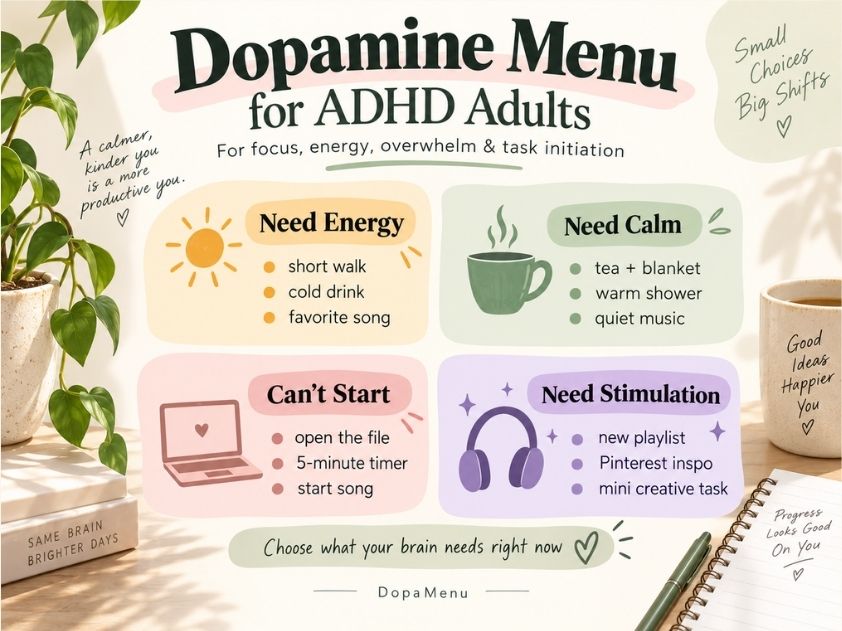
Dopamine Menu for ADHD Adults: Ideas for Focus, Energy & Task Initiation
Last updated: September 29, 2026
Sometimes I know exactly what I need to do.
I know the email matters.
I know the laundry needs folding.
I know I would probably feel better after going outside.
And somehow none of that automatically makes starting easier.
That is one reason I like the idea of a dopamine menu for ADHD adults.
Instead of trying to invent the perfect break, reward or reset when I am already tired, bored or overwhelmed, I can decide some options in advance.
A dopamine menu is usually organized like a restaurant menu — with appetizers, mains, sides, desserts and specials — but for adult ADHD life, I find it more useful when it also answers a second question:
What does my brain need right now?
Maybe I need:
- stimulation;
- movement;
- comfort;
- novelty;
- less sensory input;
- an easier way to start;
- or simply a real break.
A dopamine menu is not a treatment for ADHD and it does not literally let you control dopamine levels on command. A more useful way to think about it is as a pre-made choice system that can reduce friction when motivation or executive function is already low. That is also how current ADHD-focused explanations increasingly frame the tool.
If you want a big list first, start with my 75+ Dopamine Menu Examples.
If you want to build your own, use my free Dopamine Menu Template.
What Is a Dopamine Menu for ADHD Adults?
A dopamine menu is a personalized list of activities you can choose from when you feel stuck, under-stimulated, overwhelmed or unable to start.
The concept was popularized by Jessica McCabe of How to ADHD and commonly uses restaurant-style categories such as appetizers, mains, sides, desserts and specials.
For adults with ADHD, the useful part is not the restaurant metaphor itself.
It is this:
you separate planning from choosing.
Instead of asking yourself:
What would help me right now?
when your brain is already overloaded, you have a short list ready.
That can matter because even a simple decision can feel like one more task when you are mentally tired.
You can also build your dopamine menu into a loose ADHD-friendly daily routine instead of waiting until you’re already exhausted or understimulated to use it.
Why a Dopamine Menu Can Be Useful for Adult ADHD
Adult ADHD problems are rarely limited to “I cannot focus.”
They can show up as:
- knowing what to do but not starting;
- avoiding repetitive tasks;
- getting stuck between activities;
- scrolling because nothing else feels appealing enough;
- forgetting to take breaks;
- hyperfocusing until you are exhausted;
- feeling overwhelmed by too many options;
- struggling to restart after a break.
Current ADHD-focused guidance emphasizes that dopamine menus may be useful because they reduce decision load and lower the friction between feeling stuck and choosing a supportive activity.
For me, that is the most useful way to think about it.
Not:
How do I “hack” my brain?
But:
How do I make the next helpful choice easier?
A Realistic Dopamine Menu for ADHD Adults
Here is a simple example.
Appetizers: 2–5 Minute Resets
These should be easy enough that you can actually do them when motivation is low.
Try:
- play one favorite song;
- step outside;
- make a cold drink;
- stretch your shoulders and neck;
- pet your dog or cat;
- wash your face;
- light a candle;
- open a window;
- clear one tiny surface;
- send someone a quick message;
- eat a crunchy snack;
- sit somewhere sunny;
- change your workspace;
- do five minutes of something creative.
The best appetizer is not the most productive one.
It is the one you will actually choose.
Sides: Make Boring Tasks Easier
Sides are things you add to tasks that are necessary but painfully unstimulating.
Examples:
- focus music while working;
- audiobook while cleaning;
- podcast while cooking;
- fidget during meetings;
- body doubling;
- favorite drink while doing admin;
- standing while answering emails;
- candle while planning;
- music while folding laundry;
- using a visual timer;
- working somewhere different.
This is one of the most useful categories for adult life because many tasks cannot simply be removed.
Bills still exist.
Laundry still exists.
Emails still exist.
A side does not have to make them fun.
It just needs to make them less impossible to begin or stay with.
Mains: Deeper Resets
Mains take more time, but they can leave you feeling more restored afterward.
Examples:
- longer walk;
- yoga or Pilates;
- gym;
- creative hobby;
- reading;
- cooking something you enjoy;
- photography;
- café visit;
- long shower;
- crafting;
- gardening;
- journaling;
- puzzle;
- bookstore trip;
- time with a friend;
- working on a personal project.
One thing I would avoid is filling your mains only with things you think you should enjoy.
If “go running” has been on every self-care list you have ever ignored, it probably does not belong on yours.
Desserts: Easy Pleasure That Can Become Sticky
Desserts are the things that are very easy to start and sometimes very hard to stop.
Examples:
- TikTok;
- YouTube;
- Instagram;
- Reddit;
- gaming;
- online shopping;
- Netflix;
- Pinterest scrolling;
- phone games.
I do not think desserts need to be banned.
But for ADHD adults, it can help to decide boundaries before opening them.
For example:
- one episode;
- 10-minute timer;
- one YouTube video;
- Pinterest only for one saved topic;
- scrolling after one work sprint.
The goal is not punishment.
It is avoiding the classic:
“I wanted a five-minute break and somehow it is now 4:30.”
ADDitude similarly recommends keeping high-grab “dessert” activities bounded so they do not take over the entire break.
Specials: Bigger Things That Help You Recharge
These are activities you cannot necessarily do immediately.
Examples:
- day trip;
- movie;
- dinner out;
- museum;
- creative class;
- massage;
- nature trip;
- concert;
- bookstore afternoon;
- visiting somewhere new;
- meeting a friend;
- trying a new hobby.
I like having specials because not every reset has to happen in five minutes.
Sometimes what helps most is simply having something enjoyable ahead of you.
Dopamine Menu for ADHD Task Initiation
This deserves its own section because “I cannot start” is often very different from “I am tired.”
If I cannot start, my menu might include:
- play one designated start song;
- open only the file I need;
- set a five-minute timer;
- body double;
- change rooms;
- clear the desk;
- make a drink;
- write the tiniest first action;
- turn on focus music;
- start with the easiest visible part.
Instead of:
Work on the article.
try:
Open the draft.
Instead of:
Clean the kitchen.
try:
Put away five things.
Instead of:
Do finances.
try:
Open the spreadsheet.
A dopamine menu can help most when it reduces the gap between thinking about a task and physically beginning it. Task initiation is one of the executive-function areas frequently highlighted in ADHD-focused dopamine menu guidance.
For tasks that need to happen even when they feel painfully boring, dopamine anchoring can help you add music, sensory stimulation or another small enjoyable element to the task itself.
Dopamine Menu for Work
For workdays, I would make a much smaller menu.
Mine might look like this:
Quick reset
- favorite song;
- fresh air;
- stretch;
- pet my dog;
- cold drink;
- clear one small surface.
Energy
- short walk;
- crunchy snack;
- coffee or tea;
- quick shower;
- move to a different workspace.
Stimulation
- new playlist;
- mini moodboard;
- take a photo;
- 5 minutes of Pinterest inspiration;
- explore one interesting idea.
Back to work
- play start song;
- open only the next file;
- 10-minute timer;
- write one first step;
- change seats and begin.
This is one of the ways I personally find dopamine menus most useful: during work breaks.
I often do not need a huge self-care routine.
I just need to choose something that gives me a little energy back instead of automatically opening my phone.
The question I like most is:
What will make me feel a little better after the break?
Not only:
What sounds good right now?
That small distinction helps me separate activities that are restorative from activities that are pleasant in the moment but leave me more scattered afterward.
Dopamine Menu for Low-Energy ADHD Days
Low-energy days need a different menu.
If every option requires effort, the menu stops being helpful.
Try:
- sit outside;
- make tea;
- shower;
- eat something easy;
- listen to familiar music;
- change into comfortable clothes;
- pet an animal;
- lie down for 10 minutes;
- use a heating pad;
- watch one comfort episode;
- send a meme to a friend;
- open a window;
- order food;
- move from desk to sofa;
- read two pages.
The lower your energy, the lower the entry cost should be.
You can also create a dedicated Low-Energy Dopamine Menu instead of expecting one giant menu to work in every state.
Dopamine Menu for Overwhelm
When I am overwhelmed, more stimulation is sometimes the exact opposite of what I need.
My menu might include:
- dim the lights;
- close browser tabs;
- noise-cancelling headphones;
- brain dump everything;
- clear one surface;
- familiar music;
- simple food;
- warm shower;
- blanket;
- quiet room;
- short walk without phone;
- choose one task to ignore on purpose.
That last one matters.
Sometimes reducing the load works better than adding another “helpful” activity.
Dopamine Menu for Boredom
Boredom usually needs novelty rather than rest.
Try:
- new playlist;
- new café;
- different walking route;
- photography challenge;
- new recipe;
- random mini research topic;
- thrift store;
- bookstore;
- new craft;
- rearrange your desk;
- explore a new place nearby;
- learn one small skill;
- try a different workout;
- make something.
This is where I would intentionally include a few safe novelty options so the only available novelty is not scrolling or online shopping.
When you’re understimulated, sometimes the hardest part is simply thinking of something you actually want to do. Keep my list of 50 ADHD-friendly things to do when you’re bored nearby for those moments.
Build Your Menu Around Energy + Need
This is the framework I find more useful than only using restaurant categories.
Ask two questions:
1. How much energy do I have?
2. What do I need right now?
For example:
| Need | Very low energy | Medium energy | Higher energy |
|---|---|---|---|
| Stimulation | favorite song | new playlist | explore somewhere new |
| Comfort | tea + blanket | shower | favorite café |
| Movement | stretch | short walk | workout |
| Connection | send meme | voice note | meet someone |
| Focus | open file | 10-minute timer | focus session |
| Creativity | doodle | creative project |
This prevents a common problem:
having 50 good ideas and still not knowing which one to choose.
If you want a much bigger list to choose from, browse these 75+ dopamine menu examples
How to Make an ADHD Dopamine Menu You Will Actually Use
Keep it small.
I would start with:
- 5 appetizers;
- 3 sides;
- 3 mains;
- 2 desserts;
- 2 specials.
Then add one extra section:
When I cannot start
with three reliable options.
That is enough.
A dopamine menu does not need to become another giant life-management project.
Make it visible
Put it somewhere you will notice it before you default to your phone.
For example:
- next to your desk;
- fridge;
- Notes app;
- phone wallpaper;
- planner;
- printed card;
- inside your laptop sleeve.
Tiimo makes the same practical point: the menu works better when it is easy to access and requires very little friction to use.
Make the activities specific
Instead of:
Listen to music
write:
Play my “start working” playlist.
Instead of:
Self-care
write:
Warm shower + cozy clothes.
Instead of:
Exercise
write:
10-minute walk around the block.
Specific activities save you from needing another decision.
Include things you genuinely enjoy
Do not build a dopamine menu for your fantasy self.
You do not need:
- perfect routines;
- impressive hobbies;
- optimized breaks;
- aspirational wellness habits.
The best menu reflects what your real brain reaches for and what actually leaves you feeling better.
That realistic, personalized approach is also emphasized in current ADHD-focused guidance.
What a Dopamine Menu Is Not
A dopamine menu is not:
- a cure for ADHD;
- a replacement for medication;
- a replacement for therapy;
- a way to literally “reset” dopamine;
- a productivity requirement;
- proof that you should always be able to self-regulate.
It is simply one tool.
ADDitude explicitly describes the dopamine menu as neither a cure for ADHD or burnout nor an alternative to medication or therapy.
And sometimes the problem is not lack of stimulation.
Sometimes you are tired.
Hungry.
Burned out.
Overloaded.
Or simply need to stop working.
A menu should help you respond to yourself more easily, not pressure you into squeezing more productivity from every difficult moment.
A Simple Dopamine Menu for ADHD Adults
If you want to start today, copy this:
Appetizers
- favorite song
- cold drink
- step outside
- stretch
- pet animal
Sides
- focus music
- podcast
- body doubling
Mains
- walk
- hobby
- café
Desserts
- Netflix
Specials
- bookstore
- day trip
When I Can’t Start
- open the file
- set 5-minute timer
- start song
That is already enough.
Final Thoughts
For me, the most useful part of a dopamine menu is not the word dopamine.
It is the menu.
When I am tired, overwhelmed or stuck, I do not always need more advice.
Sometimes I just need fewer decisions.
A personal menu gives me a handful of options I already chose when I had more capacity.
Then I can look at it and ask:
Do I need energy, comfort, stimulation, movement, connection or an easier way to begin?
And choose from there.
Your menu does not need to look like anyone else’s.
It just needs to make the next helpful choice a little easier.


